

Direct-to-Chip vs Immersion Cooling: Which Is Better for AI GPU Data Centers?

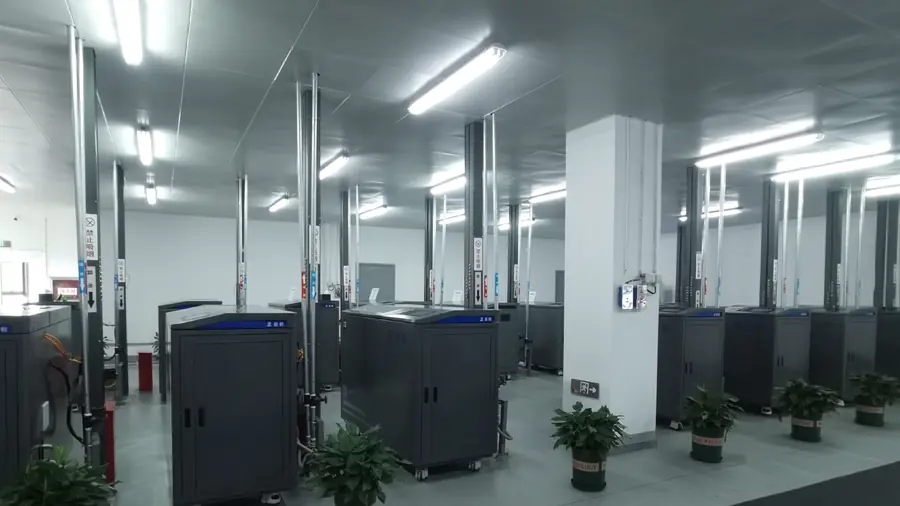
When an AI data center moves from air cooling to liquid cooling, the first question is usually not “which cooling method is more advanced.” The practical question is: which architecture can support the GPU server model, project schedule, facility water temperature, maintenance team and future expansion plan?
For most AI and HPC projects, two liquid cooling routes are compared first: direct-to-chip liquid cooling and immersion cooling. Both can remove high heat from dense computing equipment, but they change the data center in very different ways.
At XINKE LCS, we normally evaluate this decision from the complete cooling chain: GPU rack load, cold plate design, CDU capacity, manifold and piping layout, facility water temperature, outdoor dry cooler selection, leak detection, remote monitoring and maintenance access. From project experience, the right choice is not decided by cooling efficiency alone. It is decided by whether the system can be installed, monitored, serviced and expanded without creating new operational risk.
Selection Summary for AI Data Center Projects
| Project Condition | More Suitable Option | Reason |
|---|---|---|
| Mainstream GPU servers in standard racks | Direct-to-chip cooling | Keeps rack-based deployment and works better with CDU, manifold and cabinet-level maintenance. |
| Existing data center retrofit | Direct-to-chip cooling | Usually easier to route piping, add CDUs and retain part of the existing room layout. |
| Highly standardized mining or special computing equipment | Immersion cooling | Can work well when equipment, tank layout and maintenance process are designed together. |
| Fast modular deployment | Direct-to-chip cooling or project-specific immersion | Depends on server form. XINKE normally checks container layout, CDU position, pipe length and outdoor cooling source first. |
| Limited maintenance team | Direct-to-chip cooling | Rack-level service is usually easier than tank draining, board handling and coolant management. |
| Very high-density special deployment | Case-by-case | Immersion may be considered, but server warranty, coolant quality and service workflow must be confirmed first. |
What Direct-to-Chip Cooling Means in a Real Project
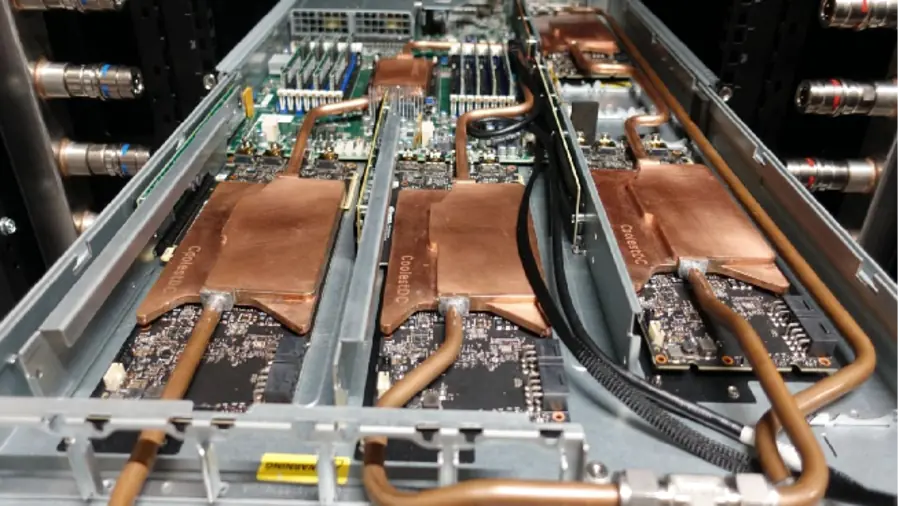
Direct-to-chip liquid cooling uses cold plates mounted on high-heat components such as GPUs, CPUs or accelerators. Coolant flows through the cold plates, absorbs the heat, and transfers it to a CDU. The CDU separates the server-side technology cooling system from the facility water system.
The heat path is usually:
GPU / CPU → cold plate → rack manifold → CDU → facility water loop → dry cooler / closed cooling tower / integrated cooling station
This architecture keeps the data center close to a rack-based format. Servers remain inside cabinets. Power and network cabling remain familiar. Maintenance teams can still work by rack, row and cabinet instead of handling submerged boards inside tanks.
For AI GPU projects, this is often a major advantage. GPU platforms change quickly. A cooling architecture that makes server replacement too difficult can become a long-term operational problem. Direct-to-chip cooling is not only about heat transfer; it is about keeping the data center maintainable while increasing rack density.
XINKE’s liquid-cooled micro module follows this logic for compact AI, HPC and edge computing projects. It integrates racks, cooling, power distribution, monitoring, cabling and fire protection into a factory-tested module, reducing the risk of different subsystems being assembled separately on site.
What Immersion Cooling Changes
Immersion cooling places IT equipment inside a tank filled with dielectric coolant. The boards or servers are submerged in the liquid, and heat is removed through the coolant and external heat exchange system.
The method can handle high heat density, but it changes the project much more deeply than direct-to-chip cooling. Before choosing immersion cooling, the project team should confirm:
- whether the server supplier supports immersion operation;
- whether the original warranty remains valid after immersion deployment;
- how boards will be removed, drained, cleaned, tested and returned for repair;
- how dielectric coolant will be filtered, stored and replaced;
- how the site will handle tank weight, lifting space and maintenance access;
- whether technicians are trained for coolant handling and tank-level service;
- how spare parts will be managed after contact with coolant.
For some standardized computing or mining projects, immersion cooling can be practical. For many AI GPU data centers, however, direct-to-chip cooling is usually easier to align with rack-based server procurement, phased expansion and routine maintenance.
Why AI GPU Projects Often Start With Direct-to-Chip Cooling
Most AI data center teams want higher rack power density without rebuilding every part of the facility operation. Direct-to-chip cooling fits this need because it allows a project to keep a recognizable data center structure while moving the highest heat load into liquid.
In XINKE project discussions, direct-to-chip cooling is usually preferred when the customer needs:
- rack-based GPU server deployment;
- CDU-based heat exchange and loop separation;
- clear supply and return coolant temperature control;
- connection with outdoor dry coolers or integrated cooling stations;
- cabinet-level maintenance instead of tank-level service;
- phased expansion from several racks to a full row or modular site;
- remote monitoring through XINKE SMART or the site management platform.
This does not mean immersion cooling has no value. It means the decision should be made from the complete project condition, not from one general statement about cooling performance.
The CDU Is Not Just a Cooling Box
In direct-to-chip cooling, the CDU is the interface between the server loop and the facility loop. If the CDU is selected incorrectly, the entire cooling system can become unstable even if the cold plates and dry cooler are good.
For AI GPU projects, we normally check these CDU parameters before selection:
| CDU Selection Item | Why It Matters |
|---|---|
| Liquid-side heat load | The CDU must match the real GPU heat captured by liquid, not only the rack nameplate power. |
| TCS supply and return temperature | Defines cold plate performance and server-side thermal stability. |
| FWS supply and return temperature | Determines whether dry cooling, closed cooling tower or mechanical cooling is required. |
| Flow rate and pressure drop | Affects pump selection, manifold balance, pipe diameter and operating energy. |
| Redundancy | Pumps, sensors, controls and cooling trains must match the required uptime level. |
| Filtration and coolant quality | Protects cold plates, pumps, valves and heat exchangers from blockage or corrosion. |
| Control communication | Allows integration with remote monitoring, BMS or XINKE SMART. |
A common mistake is asking for a “1 MW CDU” without defining flow rate, temperature difference, pressure drop, coolant type and redundancy. Two projects may both be 1 MW, but if one requires lower facility water temperature or longer piping distance, the CDU and dry cooler design may be completely different.
Outdoor Heat Rejection Decides Whether the Design Works
Both direct-to-chip and immersion cooling still need to reject heat to the outdoor environment. This is where many liquid cooling comparisons become incomplete.
For a direct-to-chip system, the heat leaves the CDU through the facility water system. That facility loop may connect to a dry cooler, closed cooling tower or integrated cooling station. The choice depends on water availability, ambient temperature, required facility water temperature and maintenance condition.
XINKE’s dry cooler for data center liquid cooling is suitable for projects that need closed-loop heat rejection with low water dependency. It is especially useful for water-scarce regions, outdoor containers, mining sites, edge computing nodes and remote AI projects.
However, dry cooling must be evaluated carefully. The project should confirm:
- facility water return temperature to the dry cooler;
- facility water supply temperature back to the CDU;
- summer design dry-bulb temperature;
- coolant flow rate;
- water or glycol concentration;
- altitude and air density;
- coil cleaning access;
- N+1 fan or complete-unit redundancy requirement.
Warm-water liquid cooling makes dry coolers more practical because higher facility water temperature gives the outdoor unit more temperature difference to reject heat. But if the required water temperature is too close to the local peak ambient temperature, the project may need larger coil area, water-assisted cooling, closed cooling tower or integrated mechanical cooling.
Retrofit Projects: Why Direct-to-Chip Is Usually Easier
Existing data centers rarely have unlimited space, pipe routes or shutdown windows. For retrofit projects, direct-to-chip cooling is often easier because it can be planned around the current rack layout and phased into operation.
A practical retrofit plan should check:
- which racks or rows will move to liquid cooling first;
- where the CDU can be installed without blocking maintenance access;
- how supply and return piping will reach each rack manifold;
- whether the existing facility water system can support the required temperature;
- how much residual air cooling remains after chip heat is captured by liquid;
- how leak detection and drainage will be arranged;
- how construction can be completed while part of the data center remains online.
Immersion cooling retrofit may require larger layout changes because tanks replace the rack-based service model. Floor loading, tank access, lifting tools, coolant handling and board maintenance must all be redesigned. It can work, but it is usually a heavier infrastructure change.
Containerized AI Data Centers: Cooling Must Be Designed as One System
For fast deployment, a containerized AI data center can reduce site construction work. But the cooling system must be designed with the container from the beginning.
XINKE’s liquid-cooled data center computing container integrates liquid-cooled cabinets, CDU, power distribution, fire protection, cooling and intelligent management into a modular platform.
For containerized AI projects, we normally review:
- server model and rack power density;
- CDU position inside or near the container;
- pipe length between container and outdoor heat rejection equipment;
- pressure drop of the facility loop;
- dry cooler layout and hot-air recirculation risk;
- maintenance clearance around the container and outdoor equipment;
- remote monitoring and alarm logic;
- future container expansion and parallel cooling units.
In this format, direct-to-chip cooling often keeps the container easier to operate because servers remain in racks. Immersion cooling containers can also be designed, but the project must plan tank access, coolant handling, service tools and spare-part workflow in advance.
Leak Risk vs Coolant Management Risk
Customers often ask whether direct-to-chip cooling is risky because of possible leakage. This is a fair concern, but it should be evaluated correctly.
For direct-to-chip cooling, the main risks are connector quality, pressure control, pipe installation, leak detection and emergency protection. These risks can be reduced through pressure testing, reliable quick connectors, proper manifold design, sensor placement and automatic alarm logic.
For immersion cooling, the risk is different. There may be fewer small pipe connections at the rack level, but the project must manage dielectric coolant quality, contamination, board service, fluid loss, cleaning and tank maintenance. The question is not which system has “zero risk.” The question is which risk the operation team can manage better.
For many AI data center operators, rack-level liquid cooling with CDU monitoring is easier to manage than a full tank-based maintenance workflow.
Project Experience: Common Mistakes When Comparing Cooling Options
| Common Mistake | Project Risk | Better Method |
|---|---|---|
| Only comparing heat removal capacity | Ignores server warranty, maintenance and future replacement | Compare full lifecycle operation and service workflow |
| Selecting CDU by kW only | Flow, pressure and temperature may not match the GPU racks | Define heat load, flow, pressure drop and temperature together |
| Ignoring facility water temperature | Outdoor cooling source may not support peak condition | Check CDU and dry cooler design as one system |
| Assuming liquid cooling removes all air cooling needs | Power supplies and network equipment may still overheat | Calculate liquid-side and residual air-side heat separately |
| Choosing immersion without service planning | Repair and spare-part handling become difficult after handover | Confirm tank access, coolant handling and board maintenance process |
| Ignoring remote monitoring | Faults may not be found before affecting IT load | Connect temperature, flow, pressure, leak and power data into one platform |
How We Normally Configure Direct-to-Chip Cooling for XINKE Projects
For a typical AI liquid cooling project, our engineering review normally follows this sequence:
- Confirm IT load: GPU model, rack power, number of racks and phased expansion plan.
- Define liquid heat capture: estimate how much heat enters the cold plate loop and how much remains as air-side load.
- Select CDU architecture: match capacity, flow, pressure, redundancy, filtration and controls.
- Design rack manifold and piping: define pipe diameter, pressure drop, quick connection method and maintenance access.
- Check facility water temperature: confirm whether the site can support the required supply and return temperature.
- Match outdoor cooling source: select dry cooler, closed cooling tower or integrated cooling station according to climate and water condition.
- Plan monitoring: connect temperature, flow, pressure, pump, fan, leak and power signals into XINKE SMART or the site platform.
- Verify commissioning items: pressure test, flow balance, alarm test, failover logic and handover documents.
This process is more reliable than starting from a product list. AI data center liquid cooling is an engineered system. Each part affects the next part.
Which Option Should You Choose?
Choose direct-to-chip liquid cooling when the project uses mainstream GPU servers, needs rack-based maintenance, may expand in phases, requires CDU-based control, or must connect to dry coolers and facility water systems in a predictable way.
Choose immersion cooling only when server compatibility, warranty, tank layout, coolant handling, maintenance tools and technician training are clearly confirmed. It can be a good solution for certain standardized high-density projects, but it should be treated as a full architecture decision, not a simple cooling upgrade.
For most AI GPU data centers, especially retrofit projects, modular micro data centers and containerized deployments, direct-to-chip cooling is usually the first route to evaluate.
Information Needed for a Practical Cooling Proposal
To prepare a useful proposal, the project team should provide:
- GPU server model and rack configuration;
- rack power and total IT load;
- number of racks in phase one and future expansion plan;
- required coolant supply and return temperature if known;
- site location and summer/winter design temperature;
- available facility water temperature or cooling source;
- water availability and water quality;
- deployment format: existing room, new data hall, micro module or container;
- required redundancy level;
- remote monitoring or BMS communication requirements.
With these inputs, XINKE can evaluate whether direct-to-chip cooling, immersion cooling or a hybrid project-specific design is more practical.
FAQ: Direct-to-Chip vs Immersion Cooling for AI Data Centers
Is direct-to-chip cooling better than immersion cooling for AI GPU servers?
For many AI GPU data centers, direct-to-chip cooling is easier to deploy because it keeps servers in rack-based cabinets, works with CDU-controlled liquid loops and supports phased expansion. Immersion cooling may be suitable for special high-density projects, but server warranty, coolant handling and tank maintenance must be confirmed first.
Does direct-to-chip cooling still need air cooling?
Usually yes. Direct-to-chip cooling removes most of the processor heat, but power supplies, network equipment, storage and other components may still release heat into the cabinet or room. The residual air-side load should be calculated separately.
What is the role of a CDU in AI data center liquid cooling?
The CDU transfers heat between the server-side cooling loop and the facility water loop. It also controls flow, pressure, temperature, filtration, pump operation, alarms and communication with the monitoring platform.
Can dry coolers support direct-to-chip liquid cooling?
Yes, especially when the system uses warm-water liquid cooling. The dry cooler must be selected according to heat load, facility water temperature, outdoor design temperature, coolant flow, glycol concentration and redundancy requirement.
Is immersion cooling easier because there are fewer rack-level pipes?
Not always. Immersion cooling may reduce some rack-level pipe connections, but it introduces tank layout, coolant quality, board cleaning, fluid handling and maintenance workflow requirements. These items must be included in the project evaluation.
Which cooling method is better for existing data center retrofit?
Direct-to-chip cooling is usually easier for retrofit because it can be added by rack or row, with CDUs, manifolds and facility water connections planned around the existing data hall. Immersion cooling often requires larger layout and maintenance changes.
Order & Project Support
If you are planning an AI data center, GPU cluster, liquid-cooled micro module or containerized computing project, send the server model, rack power, total IT load, site location, facility water condition and deployment format. XINKE LCS can help review the cooling architecture, CDU selection, outdoor heat rejection method and remote monitoring requirements before equipment selection.