

Dry Cooler vs Closed Cooling Tower: Choosing by Water Availability

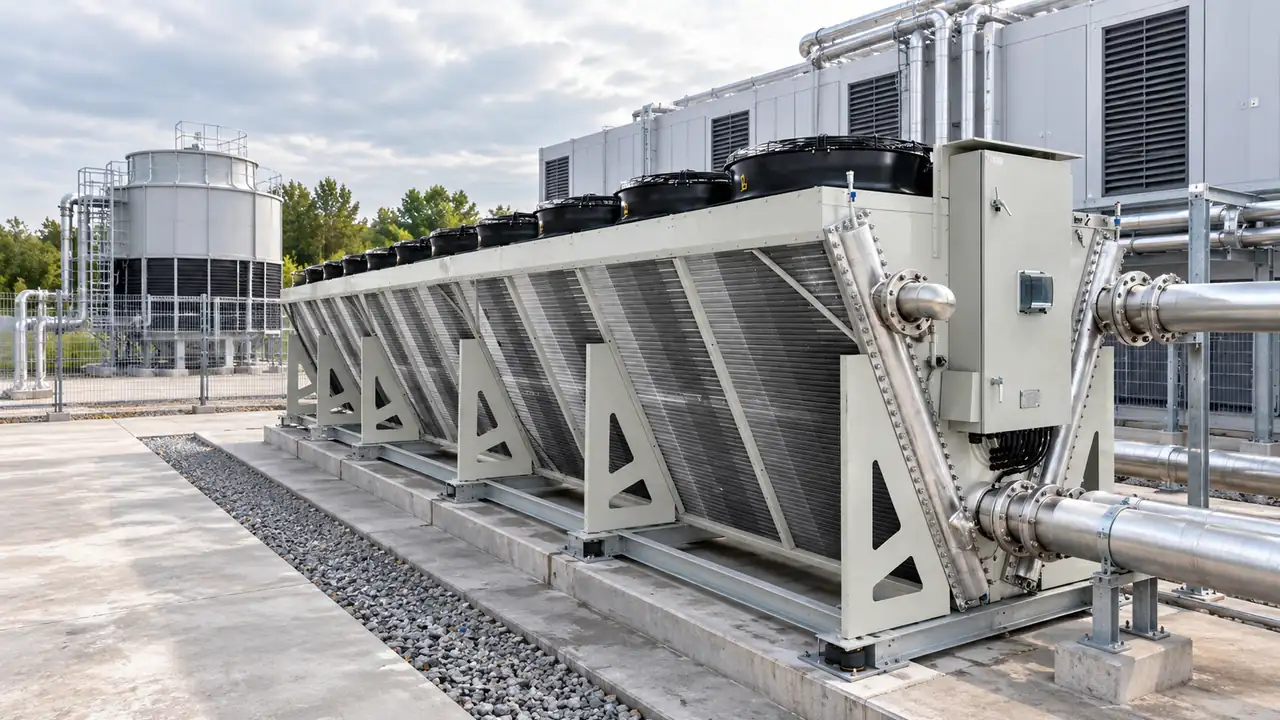
When selecting heat rejection equipment for a liquid-cooled data center, HPC facility or hydro mining project, the first question is often whether to use a dry cooler or a closed cooling tower.
The answer depends on more than cooling capacity. Water availability, water quality, summer design temperature, required coolant temperature, maintenance access and future operating costs all affect the final selection.
A dry cooler is usually the stronger choice when water is scarce, expensive, difficult to treat or unavailable at a remote site. A closed cooling tower can be more suitable when the site has a reliable water supply and requires stronger heat rejection during high ambient temperatures.
At XINKE LCS, we evaluate the complete heat rejection path from the server or miner loop to the outdoor cooling equipment. The selected unit must match the CDU, facility water system, operating temperature and control strategy.
What Is the Difference Between a Dry Cooler and a Closed Cooling Tower?
A dry cooler removes heat from a closed liquid circuit by passing the fluid through a finned coil and transferring heat to outdoor air through fans. The heat rejection process does not depend on evaporation.
A closed cooling tower also keeps the process fluid inside a closed coil. However, water is sprayed over the outside of the coil and evaporates. This evaporation removes additional heat and allows the system to approach the outdoor wet-bulb temperature more closely.
The process loop in a closed cooling tower remains separated from the spray-water loop. This protects the server-side coolant from direct contact with cooling tower water, but the spray side still requires water management.
| Selection Factor | Dry Cooler | Closed Cooling Tower |
|---|---|---|
| Heat rejection medium | Outdoor air | Outdoor air plus evaporative spray water |
| Process loop | Closed loop | Closed coil loop |
| Make-up water | Normally not required for heat rejection | Required to replace evaporation, drift and blowdown |
| Water treatment | Limited mainly to the closed fluid loop | Required for the spray-water circuit |
| Peak hot-weather performance | Limited by outdoor dry-bulb temperature | Benefits from lower outdoor wet-bulb temperature |
| Maintenance profile | Fans, coils, filters and fluid quality | Fans, coils, spray pumps, nozzles, basin and water treatment |
| Best installation environment | Water-scarce, remote or unmanned sites | Sites with reliable water supply and compact installation requirements |
How Water Availability Changes the Decision
“Water available” is not a simple yes-or-no condition. The engineering decision should consider the quantity, quality, price, treatment requirements and reliability of the water supply.
No Reliable Water Supply
For remote mining containers, desert data centers and temporary computing facilities, transporting water can become a major operating cost. A cooling tower may require regular make-up water even when the process loop itself is closed.
A dry cooler avoids the continuous evaporation associated with a cooling tower. The system still needs the correct initial coolant charge and freeze protection, but it does not depend on daily water deliveries for normal heat rejection.
This is one reason the XINKE dry cooling tower is suitable for high-temperature, arid and sandstorm-prone installations. The current platform is designed for project-specific customization from 50 kW to 2000 kW per unit.
Water Is Available but Expensive
A closed cooling tower may have a smaller installation footprint in some projects, but its operating cost includes more than the water entering the system.
The project may also need:
- Water filtration and chemical dosing;
- Blowdown management;
- Water quality monitoring;
- Spray pump electricity;
- Cleaning of the basin, nozzles and coil surfaces;
- Protection against scaling, corrosion and biological growth.
If water is available but expensive, compare the annual water and treatment cost against the additional fan power and installation area required by a dry cooler.
Water Quality Is Poor or Unstable
High mineral content, suspended solids and biological contamination can increase the maintenance burden of an evaporative cooling system. Poor water quality may require a dedicated treatment package, higher blowdown rates or more frequent cleaning.
The process coolant in a closed cooling tower is isolated inside the coil, but the spray circuit remains exposed to the site water quality. This distinction should be included in the operating plan and maintenance budget.
Water Discharge Is Restricted
Some sites have strict rules for wastewater discharge or cannot easily dispose of concentrated blowdown water. In these cases, a dry cooler can simplify the site utilities because heat rejection does not create a regular cooling-tower blowdown stream.
Water Is Available Only During Peak Summer
Some projects can support a limited amount of water use during the hottest hours but prefer dry operation for most of the year. A hybrid design can use dry cooling during mild conditions and add water-assisted cooling or mechanical refrigeration when the dry cooler cannot maintain the required supply temperature.
XINKE’s dry cooler platform can be configured with an optional water-curtain or spray assembly. This allows the project team to evaluate a dry-wet hybrid instead of operating a fully evaporative system throughout the year.
When a Dry Cooler Is the Better Choice
A dry cooler is normally preferred when the project has one or more of the following conditions:
- Limited or unreliable water supply;
- High water cost or difficult water transportation;
- Strict water consumption targets;
- Remote or unmanned operation;
- Concern about drift, scaling or biological growth;
- Requirement for a simple closed-loop heat-rejection system;
- Need for low-temperature operation with glycol protection.
Dry cooling performance depends on the difference between the required leaving-liquid temperature and the outdoor dry-bulb temperature. If the liquid must leave the cooler at 35°C and the summer design temperature is 38°C, the available temperature difference is very small. The required coil area and airflow may increase considerably.
For this reason, a dry cooler should not be selected only by nominal cooling capacity. Heat load, supply and return temperature, flow rate, summer design temperature, altitude, coolant concentration and redundancy should be confirmed together.
XINKE’s published dry cooler configuration is matched to warm-water liquid cooling architectures, including a reference condition of approximately 45°C liquid inlet and 35°C liquid outlet. The equipment uses EC variable-speed fans, optional N+1 fan-group redundancy and project-specific frame, coil and piping customization.
For the complete calculation process, see How to Size a Dry Cooler for a Liquid-Cooled Data Center.
When a Closed Cooling Tower Is the Better Choice
A closed cooling tower may be more suitable when the project has sufficient treated water and the design condition is difficult for air-only cooling.
The main advantage is evaporative heat rejection. Because the system benefits from the outdoor wet-bulb temperature, it can often reject heat at a lower leaving-fluid temperature than a dry cooler operating at the same dry-bulb temperature.
This can be valuable for:
- Hot climates with high summer design temperatures;
- Projects with limited outdoor installation space;
- Facilities that require a tighter approach temperature;
- Systems where lower fan power is more important than water consumption;
- Sites with an existing treated-water and wastewater infrastructure.
However, the water system must be designed as part of the cooling equipment. A quotation that lists only fan capacity and heat-rejection capacity is incomplete. The project should also define water quality, evaporation rate, drift control, blowdown, chemical treatment, pump duty and maintenance access.
Dry Cooler vs Closed Cooling Tower for Liquid-Cooled Data Centers
The comparison should be made at the same heat load and the same operating conditions.
| Project Question | Dry Cooler | Closed Cooling Tower |
|---|---|---|
| Can the site operate without continuous water delivery? | Generally yes | No, spray-water replenishment is normally required |
| What happens during a water supply interruption? | Heat rejection can continue if ambient conditions remain within design limits | Cooling capacity may fall when spray water is unavailable |
| How is hot-weather performance improved? | Larger coil, higher airflow, water assist or mechanical cooling | Evaporative operation uses the wet-bulb temperature advantage |
| What is the main utility burden? | Fan power and electrical capacity | Water, treatment, pumps, blowdown and fan power |
| What should be checked for a remote site? | Dust, coil cleaning, freeze protection and power availability | Water delivery, treatment, basin cleaning and biological control |
Do You Need a Hybrid Cooling System?
Many liquid-cooled facilities do not need to choose one operating mode for the entire year.
A hybrid system can use a dry cooler during cool and moderate weather, then activate a closed cooling tower, water-assisted section or compressor-based cooling source during peak summer conditions.
This approach is useful when:
- Water is limited but not completely unavailable;
- The site has a short period of extreme summer temperatures;
- The operator wants to reduce annual water consumption;
- The facility requires a stable coolant temperature under all weather conditions;
- Future expansion may increase the heat load.
The XINKE integrated cooling station supports a combined mechanical refrigeration and natural cooling strategy. During high-temperature conditions, the compressor provides active cooling. When outdoor conditions permit, the system can switch to natural cooling through a dry or closed cooling tower.
This configuration allows the CDU and heat-rejection equipment to be controlled as one system rather than as separate devices.
How We Select the Cooling Source for a Project
Step 1: Confirm the Actual Heat Load
Start with the heat transferred to the facility-side loop through the CDU. Include CDU pump heat, distribution losses, operating margin and planned expansion. Do not select the outdoor cooler only from the server nameplate rating.
Step 2: Define Supply and Return Temperatures
State the required liquid supply temperature, return temperature and flow rate. The same heat load can require very different pumps, coils and cooling equipment when the temperature difference changes.
Step 3: Collect Site Water Information
For a closed cooling tower, confirm the water source, available flow, water analysis, treatment method, discharge conditions and seasonal reliability.
Step 4: Check the Climate Design Point
Provide the summer dry-bulb temperature, wet-bulb temperature, winter minimum temperature, altitude, dust exposure and installation elevation. Annual average temperature is not sufficient for equipment selection.
Step 5: Match the CDU and Heat-Rejection Equipment
The CDU controls the interface between the server-side coolant and facility-side loop. XINKE rack-mounted, in-row and micro-module liquid cooling systems can be connected with dry coolers, closed cooling towers or integrated cooling stations depending on the project design.
Before confirming the heat-rejection equipment, review the facility water temperature and CDU requirements in Can Your Facility Water Temperature Meet Your GPU Server Inlet Requirements?.
What to Include in a Dry Cooler or Closed Cooling Tower RFQ
A useful RFQ should include the following information:
- Total heat-rejection load in kW;
- Required liquid supply and return temperatures;
- Required flow rate and allowable pressure drop;
- Summer dry-bulb and wet-bulb design conditions;
- Minimum winter temperature;
- Water or glycol concentration;
- Water source and water quality analysis;
- Required redundancy level;
- Available installation area and noise limits;
- Remote monitoring and control requirements;
- Future capacity expansion plan;
- Maintenance and spare-parts expectations.
For a dry cooler, the RFQ should state the required performance at the actual summer design temperature. For a closed cooling tower, it should also state the expected water consumption, blowdown method and treatment scope.
Frequently Asked Questions
Is a dry cooler completely water-free?
A dry cooler does not require continuous evaporative water for normal heat rejection. The system still requires an initial coolant charge and may need glycol or other freeze-protection measures depending on the climate.
Does a closed cooling tower consume water even though the process loop is closed?
Yes. The process fluid remains inside the closed coil, but the spray-water circuit loses water through evaporation, drift and blowdown. Make-up water and water treatment are therefore required.
Which system is better for a hot desert data center?
If water logistics are difficult, a dry cooler or dry-wet hybrid is usually easier to operate. If reliable treated water is available and the project requires a tighter approach temperature, a closed cooling tower or hybrid cooling station may be considered.
Can a dry cooler operate in very cold weather?
Yes, with suitable glycol concentration, low-temperature fan control, freeze protection and start-up logic. The final design must use the site’s minimum ambient temperature and actual fluid properties.
Can a dry cooler and closed cooling tower be used together?
Yes. A hybrid system can operate in dry mode when outdoor conditions are favorable and use evaporative or mechanical cooling during peak high-temperature periods.
Order & Project Support
The right selection is not simply “dry cooler versus closed cooling tower.” It is a comparison of water availability, climate, heat load, coolant temperature, operating cost, maintenance capability and expansion requirements.
When water is scarce or difficult to manage, a dry cooler can provide a simpler and more predictable heat-rejection path. When water is available and the site requires stronger hot-weather performance within a limited footprint, a closed cooling tower may be appropriate. For projects with changing seasonal conditions, a hybrid configuration can balance water consumption and cooling reliability.
XINKE LCS can coordinate the dry cooler, closed cooling tower, CDU, pump system and integrated cooling station according to the actual site conditions. Send us your heat load, supply and return temperatures, location, water conditions and redundancy target for a project-specific cooling proposal.