

How to Size a Dry Cooler for a Liquid-Cooled Data Center

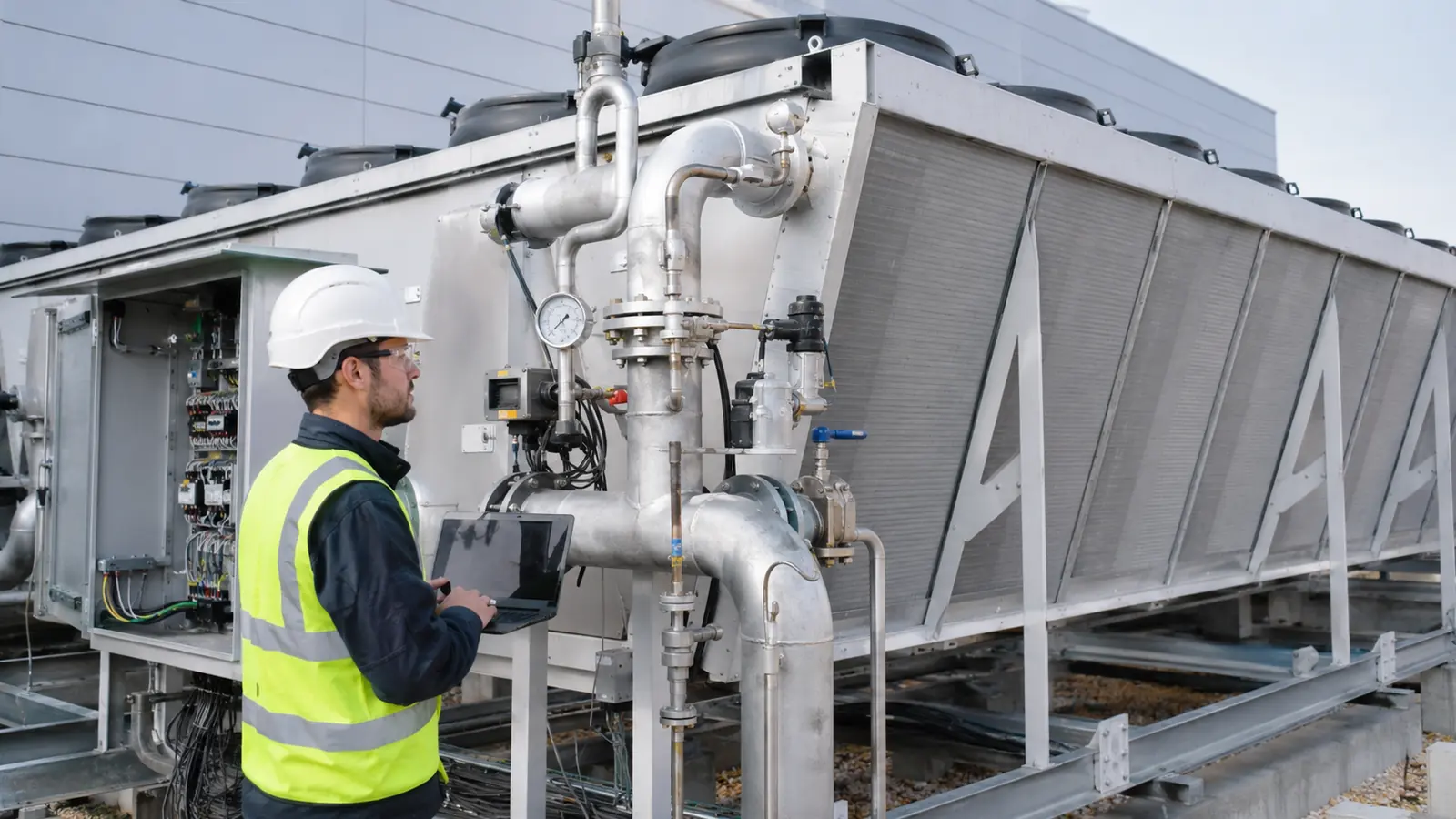
A 1 MW liquid-cooled data center does not automatically need a dry cooler simply rated at 1 MW.
The outdoor unit has to reject that heat at the site’s actual summer temperature while delivering the Facility Water System (FWS) temperature required by the CDU. Change either of those temperatures by a few degrees and the required coil area, airflow and equipment size can change substantially.
For preliminary selection, start with five inputs:
- design heat-rejection load;
- FWS entering and leaving temperatures;
- required coolant flow;
- summer design dry-bulb temperature;
- coolant type and concentration.
From there, check approach temperature, pressure drop, altitude, redundancy and future expansion.
The practical sizing path is:
Heat Load → FWS ΔT → Flow → Design Ambient → Approach → Fluid Correction → Redundancy → Final Selection
1. Start With the Facility-Side Heat Load
In a direct-to-chip liquid cooling system, the heat path typically looks like this:
Servers → TCS → CDU → FWS → Dry Cooler → Outdoor Air
The dry cooler therefore needs to reject the heat transferred into the Facility Water System, not necessarily the data center’s full electrical nameplate load.
For example, if the CDU transfers 1,200 kW into the FWS at design conditions, approximately 1,200 kW becomes the starting heat-rejection requirement.
Before adding a safety factor, check whether the project calculation already includes:
- CDU and pump heat;
- operating margin;
- future rack expansion;
- redundancy.
These are separate design considerations. Adding 20% at several stages can result in equipment that is much larger than the project actually requires.
If the liquid-side load is not yet confirmed, first establish the CDU duty using the rack load, liquid heat-capture ratio, coolant temperature and flow. See our guide on how to size a CDU for data center liquid cooling before finalizing the outdoor heat-rejection equipment.
2. Define FWS Supply and Return Temperatures
Cooling capacity alone is not enough to size a dry cooler.
The manufacturer also needs to know the fluid temperature entering and leaving the coil.
Assume:
- Heat rejection: 1,200 kW
- FWS return to dry cooler: 45°C
- FWS supply back to CDU: 38°C
The FWS temperature difference is:
ΔT = 7°C
For a preliminary water calculation:
Cooling Capacity (kW) ≈ 1.163 × Flow (m³/h) × ΔT (°C)
Therefore:
Flow ≈ 1,200 ÷ (1.163 × 7) ≈ 147 m³/h
A useful preliminary specification is now:
Reject 1,200 kW while cooling approximately 147 m³/h of water from 45°C to 38°C.
That tells a supplier far more than simply asking for a “1.2 MW dry cooler.”
If the FWS ΔT were only 5°C, the required flow would increase to roughly 206 m³/h. The thermal load is unchanged, but the coil pressure drop, pipe sizing and pump duty are not.
3. Approach Temperature Is Often the Number That Decides the Size
For dry cooling, the most important check is often the difference between the required leaving fluid temperature and the outdoor air entering the coil.
For preliminary evaluation:
Approach Temperature = FWS Leaving Temperature − Outdoor Design Dry-Bulb Temperature
Suppose the dry cooler must supply 40°C water.
| FWS Leaving Temperature | Outdoor Design Temperature | Approach | Selection Condition |
|---|---|---|---|
| 40°C | 30°C | 10°C | Relatively favorable |
| 40°C | 35°C | 5°C | More demanding |
| 40°C | 38°C | 2°C | Very demanding |
All three projects may have exactly the same kW load.
They should not be expected to use the same dry cooler.
As the approach becomes smaller, the available temperature driving force falls. Maintaining the same capacity may require more coil surface, more airflow or a different heat-rejection strategy.
Why Location Changes the Equipment
Consider two 1.2 MW projects, both requiring 38°C FWS supply.
Project A
- Design ambient: 28°C
- Approach: 10°C
Project B
- Design ambient: 35°C
- Approach: 3°C
Project B presents a much harder dry-cooling duty even though the heat load is identical.
This is why dry cooler quotations should always state the rating condition, not just nominal capacity.
4. Use the Summer Design Temperature, Not the Annual Average
A city’s average annual temperature is not a useful design point for mission-critical cooling.
If the data center must operate at full load during the hottest period of the year, the dry cooler should be evaluated at an agreed peak design condition.
Provide the supplier with:
- project city and country;
- summer design dry-bulb temperature;
- minimum winter temperature;
- altitude;
- required full-load condition.
Winter conditions matter too.
Outdoor loops in cold climates may require glycol, low-temperature fan control and freeze-protection measures. Very hot, dusty or high-altitude sites bring a different set of issues: reduced air density, coil contamination and greater airflow requirements.
XINKE’s Data Center Dry Cooler is project-configured rather than based on one fixed temperature condition. The current platform covers 50–2000 kW per unit, with parallel expansion available for larger loads.
5. Account for Glycol Before Final Selection
If the outdoor circuit can experience freezing conditions, an ethylene-glycol/water mixture may be required.
Do not select the dry cooler using water performance and add glycol later.
Glycol changes:
- specific heat;
- density;
- viscosity;
- heat-transfer performance;
- coil pressure drop;
- pump power.
The supplier should receive the actual concentration, for example:
30% ethylene glycol / 70% water
rather than simply “antifreeze required.”
XINKE’s current dry cooler platform supports both water and ethylene-glycol/water mixtures, so fluid concentration can be incorporated into the project-specific thermal and hydraulic selection.
6. Decide Whether Dry Cooling Alone Can Meet the Design Point
A useful early-stage question is:
At the hottest outdoor condition, is there enough temperature difference to deliver the required FWS supply temperature?
That leads to three common design paths.
| Design Condition | Likely Approach |
|---|---|
| Adequate approach at peak ambient | Standard dry cooler |
| Tight approach only during limited peak hours | Dry cooler with adiabatic assistance |
| Required FWS temperature remains below practical ambient dry-cooling capability | Mechanical refrigeration / integrated cooling |
Standard Dry Cooling
Where FWS temperatures are sufficiently above the summer ambient temperature, dry cooling can reject heat without compressor-based refrigeration.
Warm-water liquid cooling makes this increasingly practical because higher facility-water temperatures create a larger temperature difference to outdoor air.
Adiabatic Assistance
If only the hottest hours create an unacceptable approach, water-assisted cooling may extend the dry cooler’s operating envelope.
XINKE offers optional water-curtain or spray configurations for high-temperature conditions.
This should not be described as zero-water operation during assisted mode: once spray or wet media is operating, water is being consumed.
Mechanical Refrigeration
If the facility requires water colder than ambient conditions can reliably support, a larger dry cooler cannot solve every situation.
The project may require refrigeration for peak conditions.
XINKE’s Integrated Cooling Station for Data Centers integrates refrigeration, pumping and controls for projects where dry heat rejection alone does not cover the full annual operating envelope.
The most economical design may also be hybrid: dry cooling handles most operating hours, while refrigeration runs only when ambient conditions exceed the free-cooling limit.
7. Check the Installation Site, Not Just the Datasheet
Factory performance assumes suitable airflow.
Real installations can lose capacity if hot discharge air is drawn back into the coil.
Before final layout, check:
- spacing between dry cooler units;
- clearance from walls or screens;
- nearby buildings and obstructions;
- air discharge direction;
- maintenance access;
- prevailing wind;
- hot-air recirculation.
Altitude also matters because lower air density reduces the mass of air moved through the coil for a given volume.
For dusty or sandy environments, leave enough access for coil inspection and cleaning. A dirty finned coil does not perform like the clean coil used for selection data.
XINKE’s current dry cooler specification includes EC axial fans, optional IP54/IP55 enclosure protection and project-specific configurations for operating environments ranging from low-temperature climates to high-temperature outdoor sites.
8. Size Redundancy Separately From Spare Capacity
Suppose the required heat rejection is 1.8 MW.
Installing two 1 MW units gives 2 MW of installed capacity.
But if one complete unit is unavailable, only 1 MW remains.
That is not N+1 at a 1.8 MW critical load.
Ask:
How much IT load must remain online if one dry cooler is isolated?
Then determine the required number and size of units.
Also distinguish between:
- fan redundancy;
- complete-unit redundancy;
- pump redundancy;
- cooling-train redundancy.
XINKE’s dry cooler platform supports multiple EC fan groups and N+1 fan arrangements, but redundant fans do not replace complete-unit redundancy where the project requires it.
9. Worked Example: 1.2 MW Data Center
Consider this preliminary design:
| Parameter | Example |
|---|---|
| Heat-rejection load | 1,200 kW |
| FWS return | 45°C |
| FWS supply | 38°C |
| FWS ΔT | 7°C |
| Preliminary water flow | ≈147 m³/h |
| Summer design ambient | 35°C |
| Approach | 3°C |
| Coolant | To be confirmed |
| Redundancy | To be confirmed |
Calling this simply a “1.2 MW dry cooler” leaves out the most important part of the specification.
A better request is:
Reject 1.2 MW while cooling approximately 147 m³/h of fluid from 45°C to 38°C at 35°C outdoor dry-bulb temperature.
The 3°C approach immediately tells the supplier that this is a relatively demanding duty.
Before final selection, add:
- coolant and glycol concentration;
- altitude;
- allowable coil pressure drop;
- required redundancy;
- noise limit;
- power supply;
- installation layout.
Only then can the final coil, fan count and physical dimensions be selected properly.
10. Dry Cooler RFQ Checklist
Send these parameters when requesting a quotation:
| Parameter | Project Data |
|---|---|
| Required heat rejection | ______ kW |
| FWS return temperature | ______ °C |
| FWS supply temperature | ______ °C |
| Required flow | ______ m³/h |
| Coolant / glycol concentration | ______ |
| Summer design dry-bulb | ______ °C |
| Minimum winter temperature | ______ °C |
| Site altitude | ______ m |
| Allowable pressure drop | ______ kPa |
| Unit redundancy | ______ |
| Fan redundancy | ______ |
| Noise requirement | ______ dB(A) |
| Power supply | ______ |
| Available installation space | ______ |
| Future expansion | ______ kW |
If the FWS temperatures or peak ambient condition are missing, any equipment selection should be treated as preliminary.
Common Dry Cooler Sizing Mistakes
Buying by nominal kW.
Always compare the temperature and fluid conditions behind the rating.
Ignoring approach temperature.
A 3°C approach and a 10°C approach can lead to very different equipment.
Using average weather data.
Design around the agreed peak operating condition.
Adding glycol after equipment selection.
Use the actual fluid properties before finalizing the coil and pump duty.
Confusing fan redundancy with system redundancy.
One redundant fan does not protect against loss of an entire dry cooler.
Selecting the CDU and dry cooler separately.
Both are part of one thermal system and must operate at compatible FWS conditions.
Frequently Asked Questions
How do I determine the required dry cooler capacity?
Start with the maximum heat transferred from the CDU into the Facility Water System. Then verify that capacity at the actual FWS temperatures, coolant flow and summer design ambient condition.
What is a good dry cooler approach temperature?
There is no universal target. A larger approach generally makes dry cooling easier, while a very small approach requires more heat-transfer surface and airflow. The acceptable value depends on equipment cost, available space and operating strategy.
Can a liquid-cooled data center run without a chiller?
Yes, when the FWS temperature and local climate provide enough temperature difference for dry heat rejection throughout the required operating envelope. Warmer climates or lower FWS temperatures may require adiabatic assistance or mechanical refrigeration.
Does glycol make the dry cooler larger?
It can. Glycol alters heat-transfer properties and increases viscosity, so the required coil and hydraulic design should be recalculated using the actual mixture.
Should I oversize the first dry cooler for future expansion?
Not necessarily. For modular facilities, reserving space, piping and electrical capacity for an additional unit can be more practical than heavily oversizing the first installation.
Order & Project Support
A useful dry cooler RFQ should not say:
“We need a 1 MW dry cooler.”
It should say:
“We need to reject 1 MW at these FWS temperatures, this flow rate, this summer design temperature and this coolant concentration.”
The five numbers to establish first are:
Heat Load + FWS Supply/Return + Flow + Design Ambient + Coolant
Then confirm:
Approach + Pressure Drop + Altitude + Redundancy + Expansion
For project-specific selection, XINKE LCS can coordinate the data center dry cooler with the CDU and facility-side cooling architecture based on the site’s actual operating conditions.