

Rack-Mounted vs Sidecar vs In-Row CDU

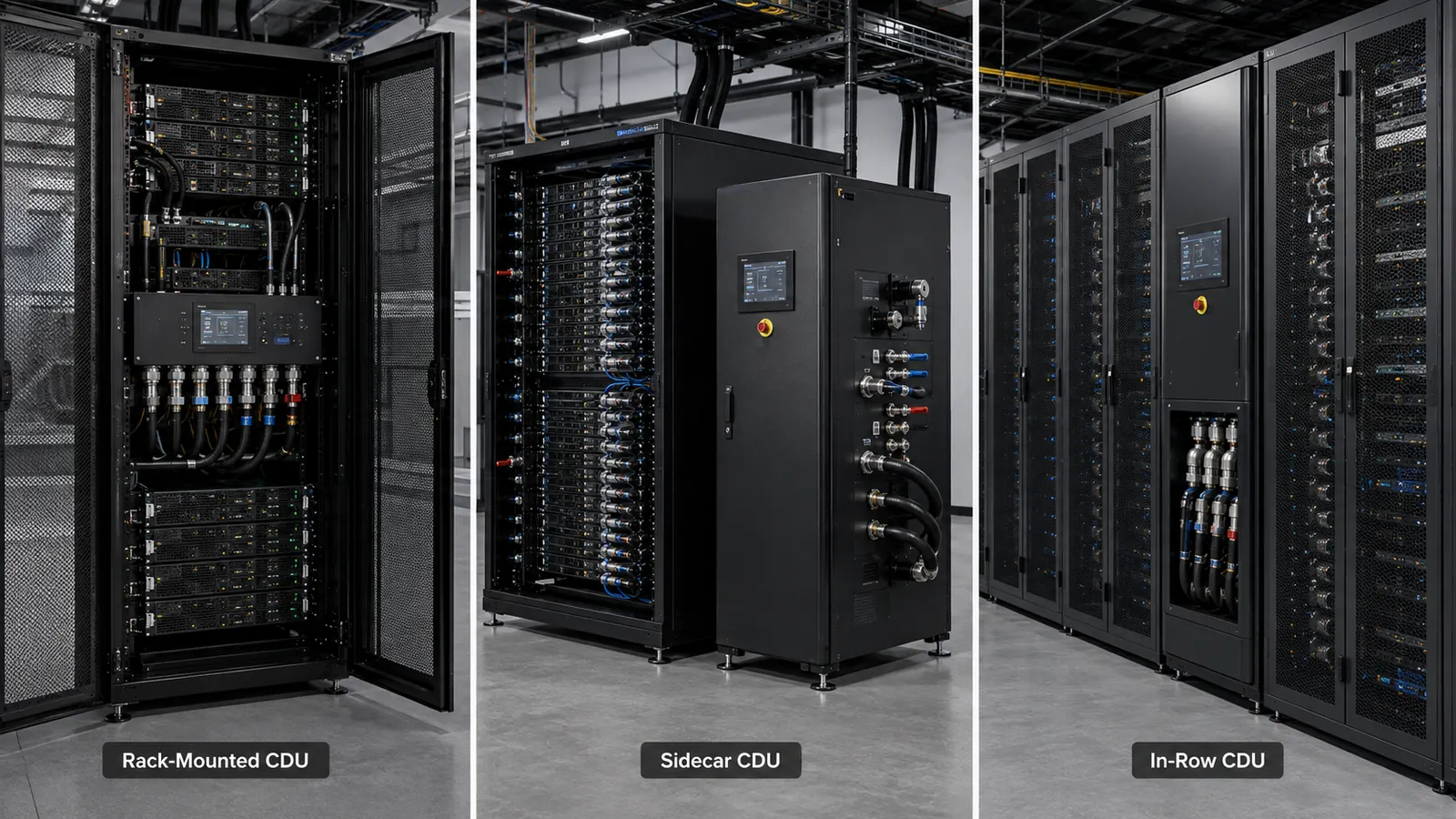
A 500 kW liquid-cooling requirement can be served by very different CDU architectures.
One project may be better suited to a Sidecar CDU, while another with the same cooling load may benefit from an In-Row CDU. A smaller deployment may be simpler with a Rack-Mounted CDU.
The decision is not based on cooling capacity alone. Rack density, coolant flow, available space, piping layout, maintenance access, redundancy and future expansion all influence the right choice.
A useful way to think about the three architectures is:
- Rack-Mounted CDU = maximum localization
- Sidecar CDU = higher local capacity without using rack U-space
- In-Row CDU = centralized high-capacity cooling for multiple racks
This guide explains where each architecture fits and when it makes sense to move from one to the next.
Quick Comparison: Rack-Mounted vs Sidecar vs In-Row CDU
| Factor | Rack-Mounted CDU | Sidecar / Enclosure-Side CDU | In-Row CDU |
|---|---|---|---|
| Typical deployment | One rack or small localized load | One or several nearby racks | Multiple high-density racks |
| Installation | Inside IT rack | Beside rack or rack group | Within or beside rack row |
| Rack U-space | Required | Not required | Not required |
| Cooling capacity | Lower | Medium to high | High to MW-scale |
| TCS piping | Very short | Short | Shared distribution headers |
| Fault domain | Small | Localized zone | Larger cooling zone |
| Maintenance | More constrained | Easy local access | Centralized service |
| Expansion | Rack by rack | Zone by zone | Capacity based |
| Best fit | Small modular deployments | High-density local cooling | Large AI/HPC clusters |
Before choosing the physical architecture, the project should already have a preliminary understanding of cooling load, flow and pressure requirements. If those values are still unknown, see our guide on how to size a CDU for data center liquid cooling.
1. When Should You Use a Rack-Mounted CDU?
A rack-mounted CDU places the heat exchanger, pumps and controls directly inside the IT rack.
XINKE LCS offers a Rack-Mounted CDU for Data Center Liquid Cooling for smaller localized cooling requirements.
The main advantage is simple: the cooling system stays close to the servers.
Short coolant paths can make it easier to manage:
- hoses and connections;
- rack manifolds;
- initial commissioning;
- hydraulic balancing;
- rack-by-rack expansion.
It also creates a relatively small failure domain. If each rack has its own CDU, a problem with one unit does not necessarily affect an entire row.
Rack-Mounted CDU Is Usually a Good Fit When:
- only a small number of racks are liquid cooled;
- the cooling load per rack is within the CDU’s practical range;
- racks will be added gradually;
- short piping is important;
- independent rack-level cooling is preferred;
- enough U-space is available.
Main Limitation: Rack Space and Capacity
The CDU competes with servers, switches and power equipment for valuable rack space.
As rack heat density increases, fitting larger pumps and heat exchangers inside the rack also becomes more difficult. For high-value GPU racks, using several U of rack space for cooling equipment may eventually become less attractive than moving the CDU outside the rack.
2. When Does a Sidecar CDU Make More Sense?
A Sidecar CDU is installed beside the IT rack rather than inside it.
XINKE LCS uses the term Enclosure-Side CDU for this architecture, designed for larger local cooling loads.
Moving the CDU outside the rack provides two important advantages: more cooling capacity and no loss of server U-space.
A sidecar enclosure can accommodate:
- larger pumps;
- larger heat exchangers;
- larger pipe connections;
- filtration;
- sensors and controls;
- easier maintenance access.
At the same time, it remains close to the racks it serves.
A Typical Transition Point
Consider four AI racks, each requiring 150 kW of liquid cooling.
Using a small rack CDU for each rack may require multiple independent cooling units and take valuable rack space. A larger sidecar CDU can instead serve the local rack group while keeping the piping relatively short.
This is why Sidecar CDUs often fit the middle ground between rack-level cooling and fully centralized in-row systems.
Sidecar CDU Is Usually a Good Fit When:
- rack load exceeds practical rack-mounted capacity;
- server U-space should be preserved;
- one CDU will serve one or several nearby racks;
- localized cooling is still preferred;
- maintenance access is important;
- a fully centralized system is not yet necessary.
Main Limitation: White-Space Footprint
A sidecar consumes floor area beside the racks.
Projects should check:
- aisle width;
- service clearance;
- facility-water connections;
- TCS pipe routing;
- cable trays;
- access for component replacement.
A technically suitable CDU can still be a poor layout choice if it blocks service access or consumes too much white space.
3. When Should You Move to an In-Row CDU?
As the number of liquid-cooled racks increases, installing separate rack-mounted or sidecar units can create too many pumps, heat exchangers and maintenance points.
An Indoor High-Power In-Row CDU can serve multiple racks through common TCS supply and return headers.
This architecture becomes more attractive for larger AI and HPC clusters.
Example
- 20 racks
- 100 kW liquid load per rack
The total liquid cooling load is approximately:
20 × 100 kW = 2 MW
At this scale, deploying many small independent CDUs may increase:
- equipment count;
- control points;
- facility-water connections;
- maintenance workload;
- commissioning complexity.
An in-row CDU can centralize pumps, heat exchangers and monitoring for a larger cooling zone.
In-Row CDU Is Usually a Good Fit When:
- multiple racks share a cooling system;
- total load reaches several hundred kilowatts or MW scale;
- large coolant flow is required;
- common TCS headers are used;
- centralized monitoring is preferred;
- future expansion is expected;
- redundancy can be engineered at system level.
The Trade-Off: A Larger Fault Domain
Centralization means one CDU may support many racks. If that CDU goes offline, more IT capacity can be affected.
Large in-row systems therefore need more attention to:
- redundant pumps;
- parallel CDUs;
- N+1 architecture;
- isolation valves;
- redundant power;
- cooling-zone design.
Instead of asking only how many racks one CDU can cool, ask:
How much IT load can be affected if this CDU is unavailable?
4. When Should You Move to the Next CDU Architecture?
There is no fixed kW threshold, but the following logic is useful during early project design.
| Project Condition | More Likely Choice |
|---|---|
| One rack with moderate liquid load | Rack-Mounted CDU |
| Small deployment expanding rack by rack | Rack-Mounted CDU |
| High-load rack exceeds practical in-rack capacity | Sidecar CDU |
| Several nearby racks need one localized cooling zone | Sidecar CDU |
| Sidecars begin consuming too much floor space | In-Row CDU |
| Multiple racks share common TCS headers | In-Row CDU |
| Cooling load moves toward MW scale | In-Row / Multiple CDUs |
| High availability and expansion are priorities | Parallel or N+1 CDU architecture |
Capacity is only one trigger. The architecture often changes because of space, flow, maintenance or redundancy before nominal cooling capacity becomes the limiting factor.
5. Why Flow and Pressure Can Change the Decision
Two projects can both require 1 MW of cooling but have very different hydraulic requirements.
For preliminary calculations using water:
1 MW at 10°C ΔT ≈ 86 m³/h
1 MW at 5°C ΔT ≈ 172 m³/h
The second system needs roughly twice the flow.
That affects:
- pump sizing;
- pipe diameter;
- manifold sizing;
- valve sizing;
- pressure drop;
- pumping energy.
A rack-mounted CDU may have enough thermal capacity on paper but still be unsuitable if it cannot deliver the required flow at the actual system pressure drop.
For this reason, CDU selection should always consider:
Cooling capacity + coolant flow + available pump head
rather than kW alone.
6. What Happens If You Choose the Wrong CDU Architecture?
Too Many Rack-Mounted CDUs
Using rack-level CDUs across a large deployment can result in:
- too many pumps;
- too many controllers;
- more maintenance points;
- repeated facility connections;
- loss of valuable rack space.
Rack-level independence is useful, but at some scale it becomes unnecessarily complex.
Too Many Sidecar CDUs
Sidecars can solve the capacity problem while creating another issue: white-space consumption.
A large number of sidecars may reduce aisle space and make piping or maintenance access more difficult.
Moving to In-Row Too Early
Centralization also has drawbacks.
An oversized shared CDU system can create:
- a larger fault domain;
- more complex hydraulic balancing;
- longer TCS piping;
- more demanding redundancy requirements.
For a small deployment, a large centralized system may be more complicated than necessary.
7. Plan for Future Expansion
Rack-Mounted: Rack-by-Rack Growth
Add another rack and another CDU. This is simple and predictable, although the total number of cooling units increases as the site grows.
Sidecar: Zone-by-Zone Growth
One Sidecar CDU can support a small rack group. Additional cooling zones can be added as new racks are deployed.
This often works well for modular projects built in phases.
In-Row: Capacity-Based Growth
Larger systems can reserve:
- header capacity;
- additional CDU connection points;
- electrical capacity;
- floor space.
Additional CDU capacity can then be installed when new compute clusters come online.
For a site expected to grow from 1 MW to several MW, planning the distribution headers early can be more useful than simply oversizing the first CDU.
8. Redundancy Can Change the Best Choice
Capacity margin and redundancy are not the same.
Suppose a project needs 1.2 MW of liquid cooling.
One 1.5 MW CDU provides spare thermal capacity. But if that CDU is offline, remaining CDU capacity is zero.
That is not CDU-level redundancy.
Critical AI and HPC deployments may instead use:
- multiple cooling zones;
- parallel CDUs;
- redundant pumps;
- N+1 CDU capacity.
Rack-mounted systems naturally create smaller cooling zones. Sidecar systems create medium-sized zones. In-row systems support larger shared zones and therefore usually require more deliberate redundancy planning.
When comparing architectures, ask two questions:
- What happens during pump maintenance?
- What happens if one complete CDU is isolated?
9. Do Not Forget the Facility-Side Cooling System
Every CDU transfers heat from the Technology Cooling System to the Facility Water System. That heat still needs to be rejected by equipment such as:
- dry coolers;
- cooling towers;
- chillers;
- integrated cooling stations.
A Data Center Dry Cooler can form part of the facility-side cooling system when project temperatures and local climate allow it.
Regardless of CDU type, the facility-side system should be checked using the same:
- design heat load;
- FWS supply and return temperatures;
- coolant properties;
- outdoor design conditions.
A correctly selected CDU cannot compensate for insufficient facility heat-rejection capacity.
Practical CDU Selection Checklist
Before deciding between Rack-Mounted, Sidecar and In-Row CDU, confirm:
- rack quantity;
- liquid cooling load per rack;
- total cooling load;
- TCS supply and return temperature;
- required coolant flow;
- estimated system pressure drop;
- available rack U-space;
- available white-space floor area;
- redundancy requirement;
- future expansion plan;
- facility-water conditions.
If several of these values are still unknown, the CDU architecture should remain preliminary until the thermal and hydraulic design is confirmed.
Frequently Asked Questions
Is a Sidecar CDU the same as an In-Row CDU?
Not always. A Sidecar CDU is generally installed directly beside a rack or small rack group and serves a localized cooling zone. An In-Row CDU normally supports a larger number of racks through shared distribution headers.
How many racks can one In-Row CDU support?
There is no fixed number. It depends on cooling load per rack, required flow, pressure drop and the CDU’s actual thermal and hydraulic duty point.
When should I stop using Rack-Mounted CDUs?
Consider moving to a Sidecar or In-Row architecture when rack loads exceed practical in-rack capacity, server U-space becomes too valuable, or the number of individual CDUs creates unnecessary maintenance and piping complexity.
Is an In-Row CDU always more efficient?
No. It can reduce equipment count in larger deployments, but it also increases the size of the cooling zone and requires more careful piping and redundancy design.
Can different CDU types be used in the same data center?
Yes. Rack-mounted units may support smaller or specialized racks while larger AI clusters use Sidecar or In-Row systems. Each cooling zone still needs to be compatible with the facility-side system.
Order & Project Support
There is no universal winner in the Rack-Mounted CDU vs Sidecar CDU vs In-Row CDU comparison.
The choice depends on how much cooling is required, where that capacity should be located, how much IT equipment can be affected by one cooling-system failure, and how the project needs to expand.
- Rack-Mounted CDU: localized, modular rack-level cooling.
- Sidecar CDU: higher local capacity without consuming server U-space.
- In-Row CDU: centralized high-flow cooling for multiple high-density racks.
For final selection, compare:
Cooling capacity + flow + pressure drop + rack layout + maintenance + fault domain + redundancy + future expansion
If you are planning an AI or HPC liquid-cooling project, contact Us with your rack quantity, rack power, TCS temperatures, coolant flow, system pressure drop and redundancy requirements for a project-specific CDU recommendation.