

Is Liquid Cooling Worth It for Bitcoin Mining? A Payback Calculation

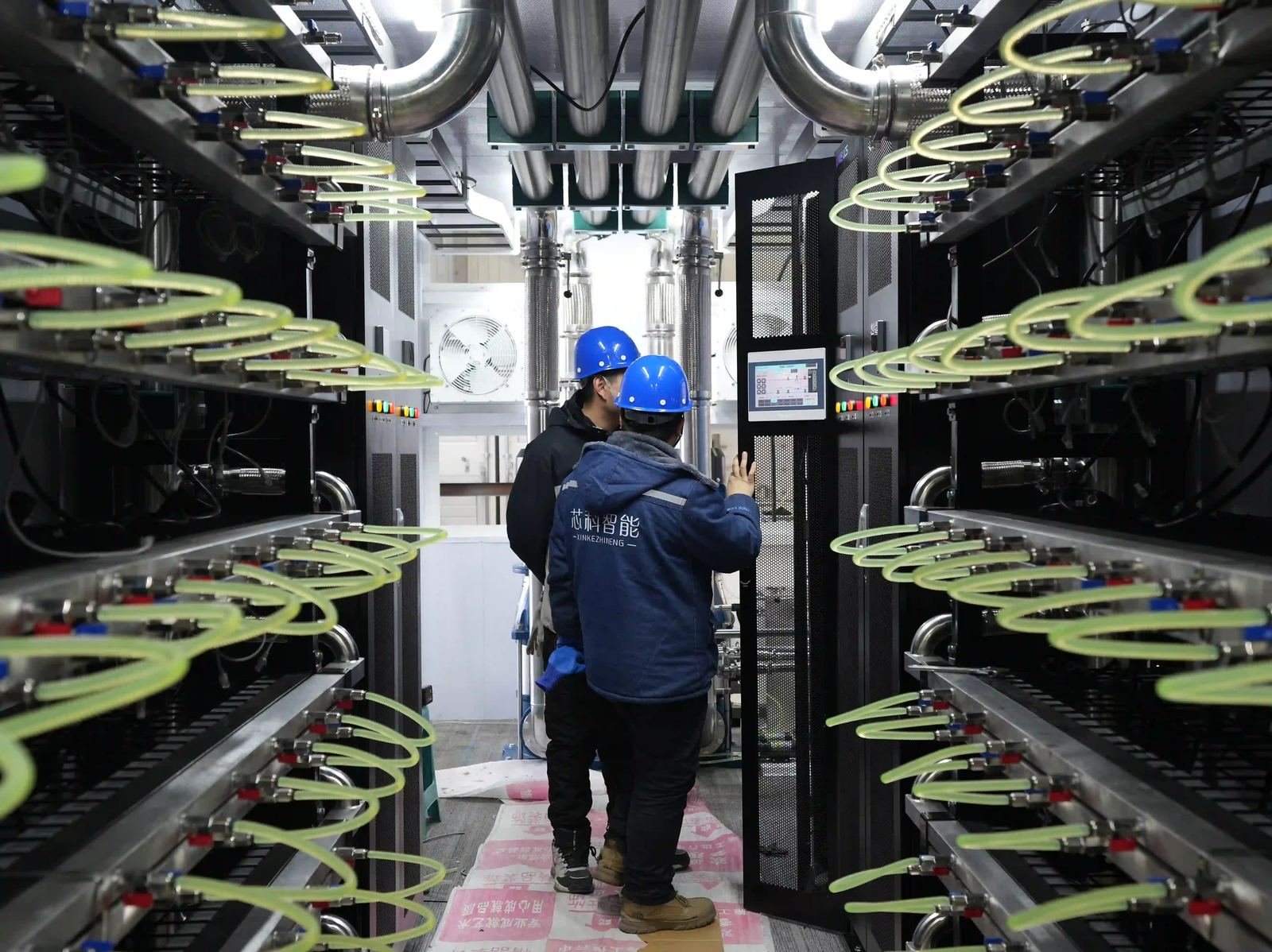
The decision between an air-cooled and a liquid-cooled mining site is normally discussed in terms of cooling performance. The governing question, however, is financial: how many months are required for the additional capital cost to be recovered, and under which operating conditions that recovery occurs.
The calculation below can be applied to a specific project using published equipment prices and site-specific power costs. A worked example is provided for a 308-position 40HQ container, followed by the break-even conditions and the factors that the model does not include.
Contents
- The short answer
- The five factors affected by liquid cooling
- The cost side
- The revenue side
- Worked example: 308-position 40HQ container
- The hashrate side
- Retrofit projects
- Factors excluded from the model
- Obtaining a project-specific figure
- Questions
The short answer
Payback (months) = Incremental capex ÷ Monthly incremental benefit
Incremental capex = liquid cooling equipment + power distribution changes + installation − the air-cooling cost avoided (ducting, extract fans, additional floor area)
Monthly incremental benefit = energy savings + additional hashrate revenue + uptime recovery + density and site savings + heat reuse income + hardware life extension
Two omissions are common in payback models prepared by operators. The first is to count energy savings alone, which understates the return. The second is to apply theoretical hashrate gains rather than measured ones, which overstates it. Both are addressed below.
The five factors affected by liquid cooling
Energy efficiency
Liquid cooling removes heat at the chip rather than from the surrounding air. This allows the ASIC to operate at a lower junction temperature, reducing leakage current and improving efficiency per terahash. The improvement is real but limited in magnitude, and its size depends on the miner models in use and on the ambient temperature at the site.
The figure should be measured on the operating fleet. Published values, including our own, are not a substitute for measurement at the site.
Thermal headroom
Because cold plates maintain a lower chip temperature, hydro-cooled miners can operate in higher power modes than the same silicon can sustain on air, particularly in a hot climate. A higher power mode produces more hashrate per installed miner and a corresponding increase in power draw. The net effect on profit per machine depends on the power price and the current hashprice, and should therefore be evaluated as a margin calculation rather than a hashrate calculation.
Uptime
Air-cooled sites lose output through summer throttling, dust-clogged heatsinks and dust-related fan failures. A sealed liquid loop is not subject to any of these. Uptime gains are the most difficult of the five factors to model and are often the largest in practice. A container rated for an ambient range of −40°C to +50°C does not require de-rating at 38°C.
Density and footprint
A liquid-cooled container accommodates several hundred miner positions within a standard 40HQ footprint. Where land is leased, where a building is required, or where the available grid connection is already fixed, density converts directly into cost.
Heat reuse
Approximately 90% of the electricity consumed by a miner leaves the site as heat. In a liquid-cooled installation this heat is available as water at 55–70°C rather than as low-grade warm air. Its value depends on the presence of a suitable offtaker, such as a district heating operator, a greenhouse or a drying process. Where such an offtaker exists, heat becomes a revenue item rather than a disposal cost.
The cost side
The cooling equipment is normally the smallest item in the project budget. Miners account for the majority.
| Line item | Basis for estimate | Reference |
|---|---|---|
| ASIC miners | current market price × position count | market |
| Liquid cooling equipment | published price for the container, rack or cabinet | From $6,000 for a 12–36 position cabinet to $40,000 for a 240-position rack or a 40HQ container solution |
| Power distribution and switchgear | per MW, site-specific | site-specific |
| Transformer and grid connection | per MW, site-specific | site-specific |
| Freight, insurance and customs | container weight × route | site-specific |
| Site preparation | minimal for containerised sites | avoids civil works |
| Commissioning | pre-commissioned at the factory | approximately 5 days on site |
| Contingency | 5–10% of the above | — |
Two items in this table require clarification. First, the prices published on our product pages are reference points rather than quotations. Antminer 12–36 position liquid cooling cabinets are listed at approximately $6,000, while the 240-position liquid cooling rack and the 308-position 40HQ container solution are listed at approximately $40,000. Second, a containerised site eliminates most civil works and reduces on-site commissioning to approximately five days. This is a saving in both capital and schedule that air-cooled construction also incurs but rarely quantifies.
The revenue side
Monthly revenue is determined as follows:
Monthly revenue = hashrate (TH/s) × uptime (%) × hashprice ($/TH/day) × days
Liquid cooling affects the first two terms. The third, hashprice, is a market input outside the operator’s control and declines over time as network difficulty rises. A model that holds hashprice constant over three years does not reflect operating conditions.
Worked example: 308-position 40HQ container
Consider the Antminer 308-position liquid cooling container. Its published installed power load is 1,694 kW across 308 bays, equivalent to 5.5 kW per bay.
| Metric | Basis | Result |
|---|---|---|
| Installed power load | published specification | 1,694 kW |
| Load per bay | 1,694 kW ÷ 308 | 5.5 kW |
| Annual energy at 100% uptime | 1,694 kW × 8,760 h | 14.84 GWh |
Annual energy cost at four power prices:
| Power price | Annual energy cost at 1,694 kW |
|---|---|
| $0.04 / kWh | $593,578 |
| $0.06 / kWh | $890,366 |
| $0.08 / kWh | $1,187,155 |
| $0.10 / kWh | $1,483,944 |
Against a $40,000 cooling container, the value of a given efficiency improvement is as follows:
| Energy reduction | Annual saving at $0.08 / kWh | Recovery period |
|---|---|---|
| 2% | $23,743 | 20.2 months |
| 5% | $59,358 | 8.1 months |
| 10% | $118,716 | 4.0 months |
The same relationship expressed in reverse, as the efficiency improvement required to recover the equipment cost within twelve months:
| Power price | Efficiency improvement required for 12-month recovery |
|---|---|
| $0.04 / kWh | 6.7% |
| $0.06 / kWh | 4.5% |
| $0.08 / kWh | 3.4% |
| $0.10 / kWh | 2.7% |
At the power prices typical of industrial sites, an efficiency improvement in the low single digits is sufficient to recover the cost of a $40,000 cooling container within twelve months on energy alone, before any additional hashrate or recovered uptime is taken into account.
This also explains a pattern that is otherwise counterintuitive. The cash return on liquid cooling is fastest where power is expensive; yet liquid cooling is most often required where power is cheap and the climate is severe, because a low-cost power site that throttles through the summer does not in practice deliver low-cost hashrate.
The hashrate side
Higher power operation is a margin decision rather than a hashrate decision:
Monthly benefit of higher power mode = (additional hashrate × hashprice) − (additional watts × 24 h × 30 × power price) − (change in failure rate × replacement cost)
Where this result is negative at the applicable power price, miners should be operated in normal mode and the efficiency gain taken instead. A liquid cooling system supports either configuration.
Retrofit projects
A retrofit has a different cost structure because part of the existing infrastructure may remain in use. The principal risk is to assume that the existing loop can support the new miners. Higher flow requirements, different hydraulic resistance, or a lower permitted inlet temperature can each reduce the number of miners an existing installation is able to support. The position count shown on the original drawing does not answer this question. A component-by-component assessment is set out in our guide to hydro mining cooling system upgrades.
Factors excluded from the model
The following factors lie outside the calculation above and should be assessed separately.
- Difficulty growth and halvings. Hashprice declines over time, and recovery periods lengthen when the model is projected forward rather than held at current economics.
- Curtailment. Where a site is powered down during periods of high power prices, uptime and revenue are no longer linked.
- Failure. A leak event that damages a rack of miners costs more than the cooling system. Insurance, warranty terms and leak detection form part of the payback calculation rather than sitting outside it. For this reason the specification uses 304 stainless seamless piping, every circuit is pressure-tested, and leak detection is available as an option.
- Measured versus theoretical efficiency. Published figures generally represent best-case performance and should be verified at the site, under site ambient conditions.
- Maintenance and consumables. Coolant, filtration and periodic inspection are operating costs. They are smaller than energy costs but not negligible.
- Site skills. Liquid cooling places greater demands on the operating team than air cooling. Where no one on site is able to work on a loop, training and remote support should be included in the plan. Our full lifecycle service addresses this requirement, which is a common gap at overseas sites.
Obtaining a project-specific figure
The calculation above establishes an order of magnitude. Converting it into a decision requires the load profile, site conditions, the climate design point and equipment selection. These are covered by the pre-sales assessment, which includes site survey, computing load evaluation, solution design, and a cost analysis covering investment budget, OPEX, recovery period and profit modelling.
A quotation can be prepared from three inputs: site location, power price and target capacity. Requests may be submitted through our contact form. Equipment specifications and solution documents are available in the download center.
Method and sources. The installed power load, bay count and equipment reference prices used above are taken from published product specifications. Efficiency improvement values are illustrative, since the actual result depends on the miner models and ambient conditions at the site and should be measured before capital is committed. The cost and revenue structure follows the format used in project cost analyses during pre-sales assessment.
Questions
Is liquid cooling financially justified for Bitcoin mining?
The answer depends on the power price, the ambient conditions and the measured efficiency improvement. At $0.08/kWh on a 1.7 MW site, a 3.4% efficiency improvement recovers the cost of a $40,000 container within twelve months. Where power is inexpensive but the climate causes throttling, the return is more likely to come from recovered uptime and hashrate than from energy savings.
What does a 40HQ liquid-cooled mining container cost?
Published reference pricing for our 40HQ container integrated cooling solutions starts at approximately $40,000 for the cooling and integration scope. Miner cost, power distribution, transformer and freight are additional and depend on the site.
Does liquid cooling increase hashrate?
It provides the thermal headroom for miners to operate in higher power modes, which increases hashrate per machine and power draw together. Whether the change is profitable depends on the power price and the current hashprice.
How long does installation take?
Standard products ship within 7–15 days and large customised projects within 30–45 days. A pre-commissioned container requires approximately five days of on-site commissioning.
Should a remote or extreme-climate site use a dry cooler or a cooling tower?
The choice depends on water availability. A dry cooling tower rejects heat without evaporative water loss and is the usual selection for water-scarce or desert sites. A cooling tower is more efficient where water is available.