

Hydro Mining Cooling System Upgrade: What to Check for New ASIC Miners

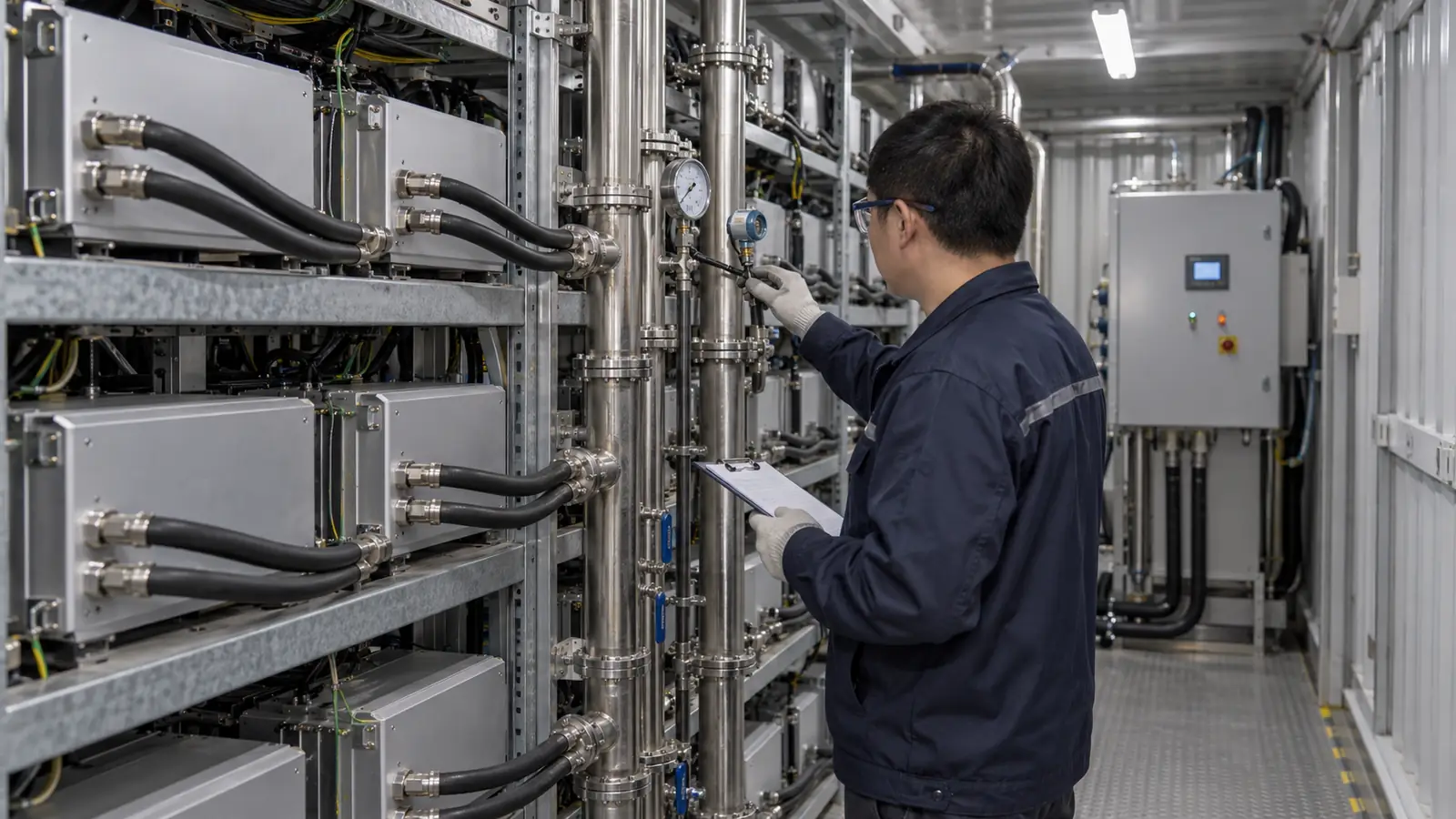
Replacement hydro miners may fit the existing racks and connect to the available hoses, yet exceed the operating capability of the cooling installation. Higher flow requirements, different hydraulic resistance or a lower permitted inlet temperature can reduce the number of miners the system supports.
For an upgrade project, the useful question is: how many of the proposed miners can the existing infrastructure support at the required operating conditions, and which modification would increase that number?
Our recommendation is to assess reuse component by component. The enclosure, racks, piping, pumps and outdoor cooling equipment do not necessarily need replacement together. Each should be retained where its condition and performance meet the new requirement.
The objective is to identify the constraint that limits the upgrade before committing to replacement equipment.
Establish the New Duty Before Counting Available Positions
The original miner count describes an installation configuration. It does not establish compatibility with every later model from the same manufacturer.
Fix the proposed miner model, version, intended operating mode and installation quantity first. A comparison based only on brand or hashrate leaves important infrastructure requirements unresolved.
Improved mining efficiency does not necessarily reduce demand per installed position. A replacement model can consume less energy per unit of hashrate while drawing more power per machine. The upgrade must therefore be assessed against its intended electrical and cooling duty.
Separate information supplied by the miner manufacturer from the existing system data and measurements needed on site.
| Information source | Required information | Decision it supports |
|---|---|---|
| Replacement miner documentation | Power at the intended operating mode, coolant flow requirements, pressure-drop data, permitted temperature and pressure, approved fluid, dimensions and connections. | Defines the duty and compatibility requirements of the new equipment. |
| Existing cooling-system documentation | Pump curves, piping arrangement, valve and connector specifications, heat-rejection selection conditions and control description. | Identifies equipment that may be retained and assumptions that need verification. |
| Existing electrical documentation | Available supply, distribution arrangement, branch ratings, cables, connectors and auxiliary loads. | Establishes electrical constraints independently of cooling capacity. |
| Site operating records and measurements | Active miner quantity and load, supply and return temperatures, flow, differential pressures, pump speed and outdoor conditions. | Checks actual performance and provides a baseline for the proposed modification. |
Record measurements under the same stable operating condition. Combining a maximum flow reading from one day with temperature readings from another can produce a misleading picture of available capacity.
For example, BITMAIN’s published S21 XP Hyd specification lists flow, inlet-temperature and pressure requirements separately. Those model-specific limits must be checked individually.
Maximum permitted coolant pressure must also be distinguished from pressure drop through the miner. One limits allowable operating pressure; the other helps determine the differential pressure required to deliver flow. If the necessary pressure-drop information is unavailable, it remains an unresolved input rather than a value to infer from the maximum pressure rating.
Calculate the Quantity Each Part of the System Can Support
An upgrade can be limited by physical space, electricity, circulation or heat rejection. Comparing these constraints reveals where further engineering work should concentrate.
Consider the following hypothetical screening example. Assume an installation has 200 suitable positions, 1,100 kW available for miners after auxiliary allowances, and 1,000 kW of liquid-side heat-rejection capacity at the specified site conditions.
For the proposed piping and miner arrangement, assume hydraulic assessment also establishes that the system can deliver 1,600 L/min at the required differential pressure and fluid condition.
Each replacement miner is assumed to require 6.0 kW of electrical input, transfer 5.7 kW into the coolant and require 10 L/min at the selected design point.
| Constraint | Illustrative calculation | Initial quantity limit |
|---|---|---|
| Suitable installation positions | Physical limit | 200 miners |
| Available miner electrical capacity | 1,100 kW ÷ 6.0 kW | 183 miners |
| Liquid-side heat rejection | 1,000 kW ÷ 5.7 kW | 175 miners |
| Circulation at the assessed duty | 1,600 L/min ÷ 10 L/min | 160 miners |
These are illustrative values, not ratings for a particular miner or XINKE product. The results are screening limits before project margins, tolerances and detailed branch verification.
Crucially, 1,600 L/min is not a fixed capacity available under every configuration. Actual flow depends on the pump, fluid and connected circuit. Changing miner quantity, valve positions or piping changes the system resistance and may change the delivered flow.
The division is useful only after circulation capability has been established for the proposed arrangement. Even then, the most disadvantaged branch must receive its required flow.
In this example, improving circulation alone would not establish capacity for 200 miners. Heat rejection would become the next identified constraint. This is why we recommend evaluating the complete upgrade before purchasing a larger pump.
Find Where the Hydraulic Restriction Occurs
A replacement miner can change both the required flow and the resistance of its branch. Existing hoses, connectors and headers add further losses.
The pump must deliver the new total flow at the differential pressure required by that completed circuit. Its original nameplate or quotation cannot establish that operating point.
When flow is insufficient, the location of the restriction determines the appropriate modification.
- A restrictive branch connection may justify changing the hose, connector or local valve arrangement.
- Excessive header losses may require changes to distribution piping or the grouping of connected miners.
- Insufficient pump duty may require a different pump package after the circuit requirements are established.
- Uneven distribution may require balancing or control changes rather than additional total pumping capacity.
Increasing pump pressure without identifying the restriction can increase flow through easier paths while leaving a disadvantaged branch short of coolant. It can also move other equipment closer to its pressure limits.
Our engineering position is that a pump upgrade should address a demonstrated shortage of available differential pressure at the required flow. It should not be the default response to every cooling complaint.
Assess Mixed Miner Models as Their Own Operating Configuration
Many projects replace miners in batches. During that transition, old and new units share infrastructure despite having different cooling requirements.
At a given supply-to-return pressure difference, branch flow follows the resistance of each path. It does not automatically divide according to the needs of each miner.
If a replacement model has a higher-resistance cooling path, it may receive less flow than an older model connected across a similar pressure difference. The system’s total flow can appear adequate while individual new miners remain under-supplied.
Total flow is therefore not sufficient evidence of mixed-model compatibility. The assessment needs to establish flow through representative branches, including those expected to be most disadvantaged.
The first response is to identify whether suitable balancing or branch modifications can achieve the required distribution within equipment limits. Grouping similar models into defined sections may help where the existing arrangement supports it.
Separate circuits become relevant when requirements cannot be reconciled, or when the proposed arrangement cannot provide acceptable distribution and control. They are not automatically necessary whenever models differ.
Temperature and fluid requirements also need a shared acceptable range. If the connected models cannot use the same approved coolant or operate within a common supply-temperature range, changing pump speed will not resolve the incompatibility.
For an existing hydro mining container divided into independent circulation sections, assess whether replacement can be organized by section. Then check any shared outdoor cooling equipment, electrical supplies and controls. Separate internal loops do not necessarily make the complete systems independent.
The transition arrangement should have its own supported quantity and operating conditions. Approval of the original fleet or the final fleet does not automatically cover every intermediate mixture.
Recheck Outdoor Cooling at the New Temperature Requirement
Existing heat-rejection equipment may become unsuitable even when the increase in total heat load is modest.
The reason can be a change in required coolant temperature. A dry cooler rejecting heat at a higher fluid temperature has a different duty from the same equipment being asked to produce cooler fluid under the same outdoor conditions.
For an existing dry cooling system, reassess the proposed heat load together with the required fluid temperatures, site design air conditions, coolant properties and flow.
Where a heat exchanger separates the miner loop from the outdoor circuit, include its performance and temperature approach. The outdoor equipment must provide conditions that allow the required miner supply temperature to be achieved through that exchanger.
Equipment condition matters as well. Coil fouling, airflow obstruction or recirculation can reduce available performance compared with the original selection.
A successful trial in cool weather confirms performance at the tested condition. It does not establish that the upgraded installation can sustain the same load during the site’s design summer conditions.
Choose the Modification That Removes the Actual Constraint
The assessment should produce a defined reuse decision for each major part of the installation.
| Assessment result | Appropriate direction to evaluate |
|---|---|
| Existing equipment meets the proposed duty and remains in suitable condition. | Retain it, make necessary setting or documentation changes, and verify the modified installation. |
| Shared capacity is adequate, but mounting or connections differ. | Modify mounting, hoses, connectors or branch connections while preserving service access. |
| Required flow is not delivered through the proposed circuit. | Identify branch, header and pump constraints before selecting hydraulic modifications. |
| Heat rejection is insufficient at the new load and inlet requirement. | Evaluate additional or replacement heat-rejection capacity and any associated exchanger changes. |
| Old and new models cannot share acceptable fluid or temperature conditions. | Evaluate circuit separation and its effect on shared infrastructure. |
| Several major limits are reached simultaneously. | Compare the completed cost and operating consequences of a retrofit with a dedicated new installation. |
Electrical suitability remains an independent requirement. Adequate upstream power does not establish that every internal branch, cable, connector and protective device can support the replacement model.
Mechanical fit should include hose bend requirements, connection access and removal space. A miner that fits between shelves may still create an impractical maintenance arrangement.
Reuse is valuable where it preserves suitable equipment without creating disproportionate modification costs or operating restrictions. A lower-density upgrade can be reasonable if it meets the project objective; filling every available position should not become an assumption that drives unnecessary replacement.
Verify the Proposed Arrangement Before Full Deployment
A limited trial can resolve remaining uncertainty after the proposed electrical and hydraulic conditions have been reviewed.
Select representative locations, including branches expected to be hydraulically disadvantaged. Testing one replacement miner beside the pump provides little evidence about a remote branch.
Under stable, documented loads, record miner inlet and outlet temperatures, assessed branch flows, relevant pressures, pump speed and loading, outdoor conditions, and the effect on any older miners still connected.
The trial should answer a specific question: does the proposed configuration distribute sufficient coolant and maintain acceptable conditions, or does it reveal a local restriction or shared-capacity limit?
If continued operation during a pump outage is part of the requirement, assess the specified standby condition as well. Performance with all equipment available does not establish the capacity remaining during maintenance.
Use measured results alongside the site-condition assessment to define the supported miner quantity, required modifications and remaining expansion limits.
Order & Project Support
For a hydro mining cooling system upgrade, share the existing layout, pump and cooling-equipment specifications, current operating records and proposed miner models with our project team.
Include the intended operating mode, target quantity, site conditions and whether old and new miners will operate together during replacement.
A useful upgrade proposal should identify what can remain, what limits the proposed quantity, and which modification adds usable capacity. Those conclusions provide a sound basis for equipment purchasing before the full replacement fleet arrives.