

As the “prefabrication” trend reaches token-mining facilities, Xinke’s standardized containerized computing solutions have already been proven through years of practical application.

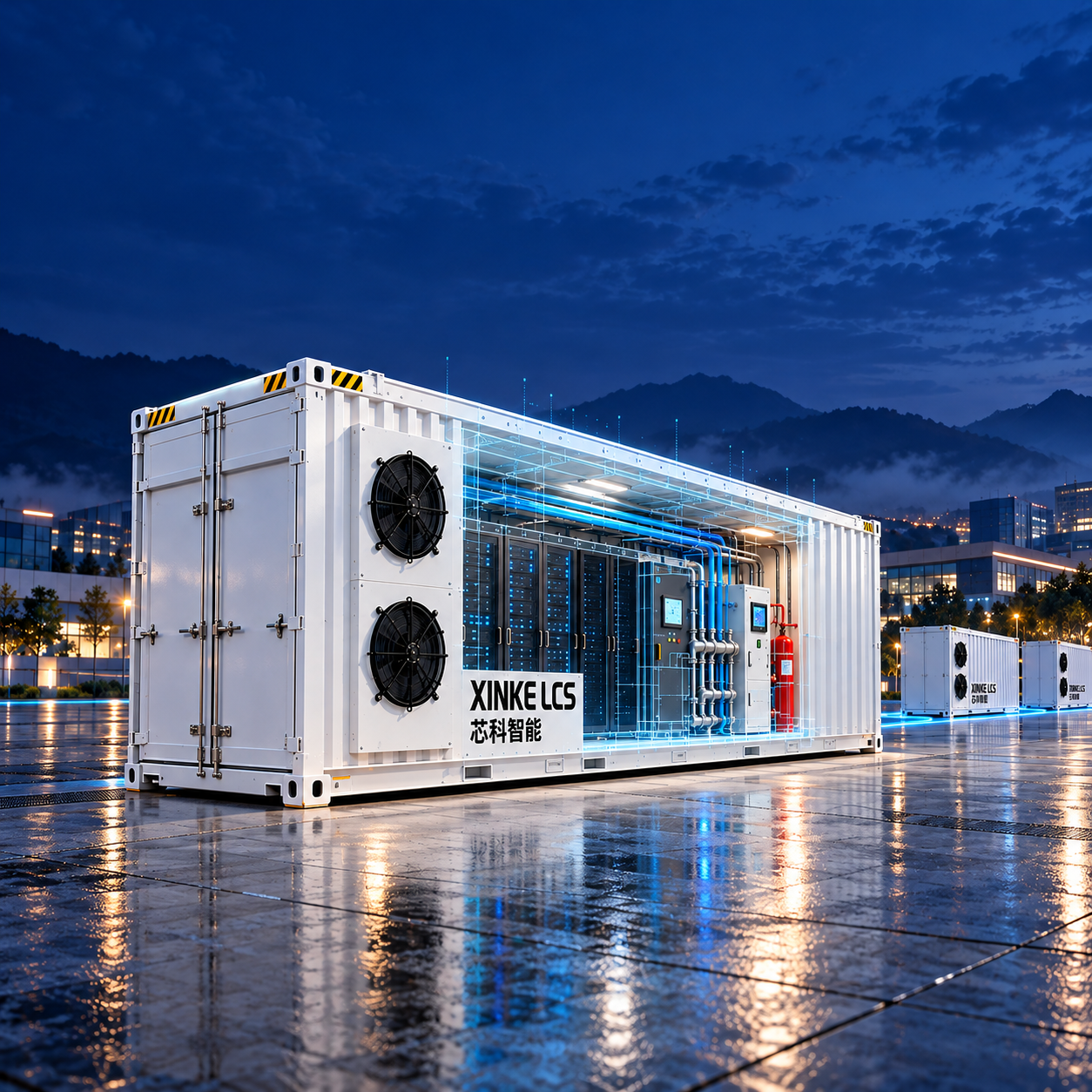
Can a data center be fully integrated in a factory and then rapidly commissioned upon arrival at its destination?
On October 21, at the GTC conference in Berlin, NVIDIA unveiled its DGX POD reference design: an “AI factory” housed within a modular container. Fully integrated and verified prior to delivery, the system can be deployed at a prepared site in as little as 14 days.
To use an apt analogy, the AI factory is adopting a “pre-prepared meal” model—completing complex integration tasks in advance to make on-site deployment more efficient and predictable.

For Xinke, the deployment of computing power via containerized units is a practice with a long-standing history.
As early as 2021, within the blockchain sector, Xinke began integrating high-performance computing (HPC) servers into various types of containers—incorporating essential functions such as power supply and distribution, liquid cooling, centralized management, and fire protection. In recent years, this integration expertise has expanded into the data center sector, with containerized modular solutions successfully deployed and operational across multiple regions in China.
From blockchain-focused computing containers to data center modules, Xinke has consistently refined its prefabricated, modular container solutions through hands-on engineering, offering a fresh approach to the delivery of computing infrastructure.
Break away from established construction patterns to accelerate the deployment of computing power.
The construction of traditional data centers involves civil works, interior fit-outs, equipment installation, and the commissioning of multiple systems. This process entails numerous stages and complex interfaces, making project timelines highly susceptible to on-site conditions.
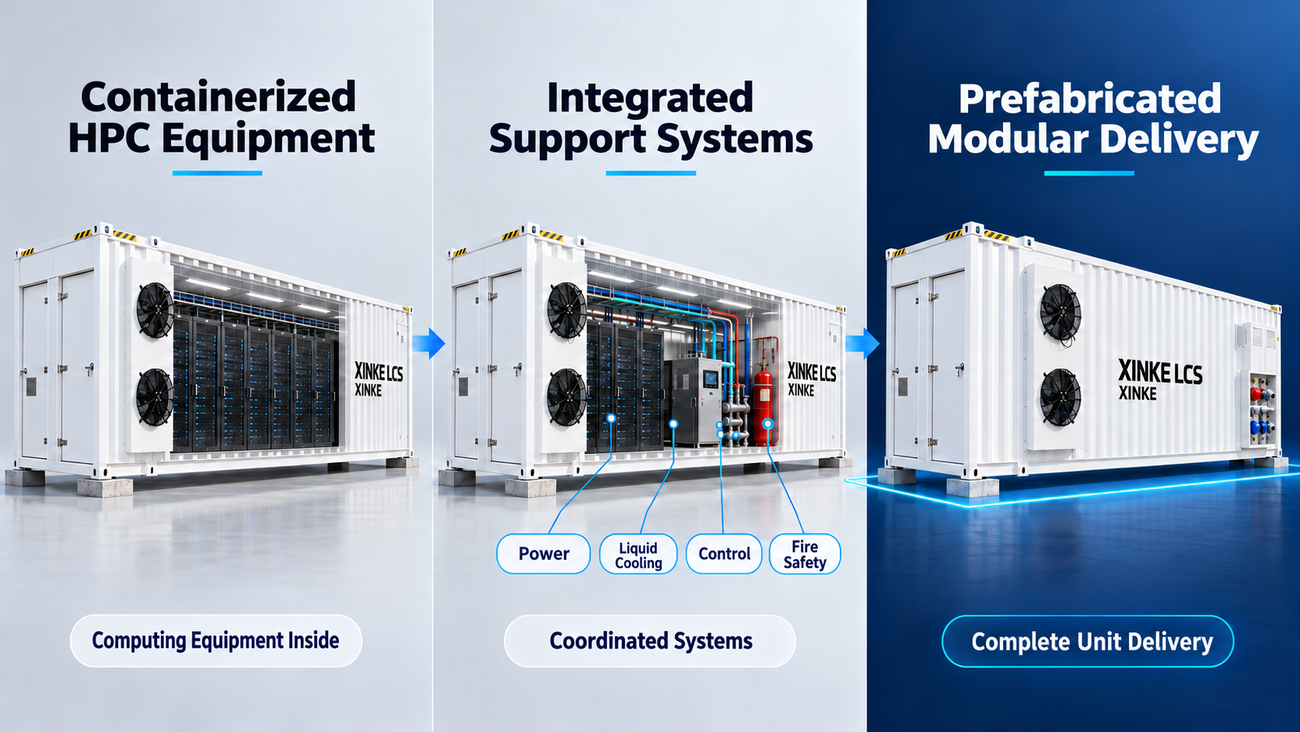
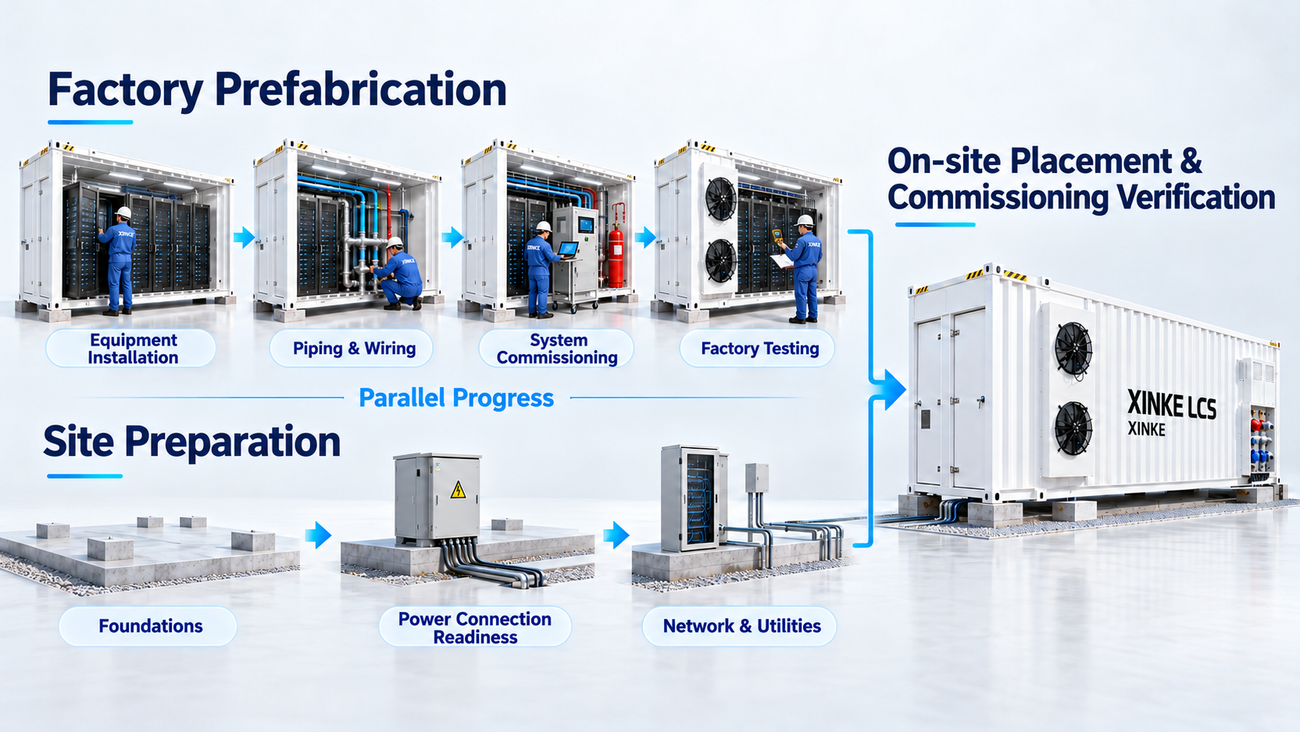
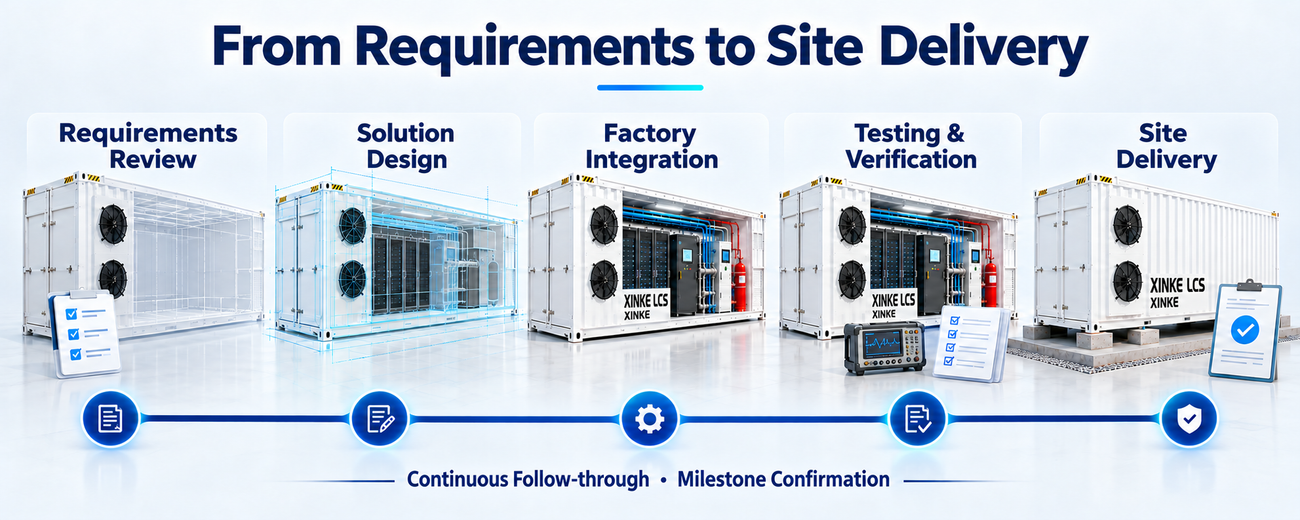
Xinke shifts a significant portion of on-site work to the factory by integrating power supply and distribution, liquid cooling, server racks, and monitoring systems. Pre-assembly, wiring, pressure testing, system integration, and quality verification are all completed before the equipment leaves the factory—thereby minimizing on-site construction requirements and the need for extensive, repetitive coordination.
According to the project lifecycle defined by Silicon Labs, standard projects can be implemented within 2–3 months, while specific fast-track scenarios can be compressed to 6 weeks. Provided that the equipment has arrived, site infrastructure—including power supply and network connectivity—is ready, and all acceptance criteria are met, on-site commissioning can be achieved in as little as 72 hours.
Overall project delivery and on-site deployment are distinct phases. By conducting factory prefabrication in parallel with site preparation, waiting times can be reduced; this also helps minimize reliance on local construction resources for overseas projects.
Break the fixed boundaries and let the infrastructure move with the business
Computing power requirements and deployment locations will change, and part of the civil construction and decoration investment in traditional computer rooms is difficult to migrate with the business.
The prefabricated modular container solution integrates equipment and supporting systems in the factory to support overall transportation, hoisting and rapid on-site deployment. When the business is transferred or the site is adjusted, it can be redeployed after re-checking transportation, power supply, heat dissipation and site conditions.
This portable and reusable approach provides enterprises with more flexible investment options and extends the value of infrastructure to the entire use cycle.
Modular design allows for flexible assembly, with built-in capacity for future reconfiguration and expansion.
Regional certification standards, data center facility requirements, and the specific power supply and cooling needs of different hardware models all influence solution design. By taking into account local site conditions, operational workloads, and equipment configurations, Xinke provides tailored modular solutions—ensuring that prefabricated delivery achieves a balance between standardization and adaptability.
Regarding power supply and distribution, configurations are planned based on load scale, redundancy requirements, and equipment interfaces. For cooling, solutions are matched to the heat dissipation needs of specific hardware, the ratio of air-to-liquid cooling, and rack density. In terms of spatial layout, designs are developed by considering the number of racks, equipment dimensions, and maintenance requirements, ensuring that all systems operate in coordination within a unified solution.
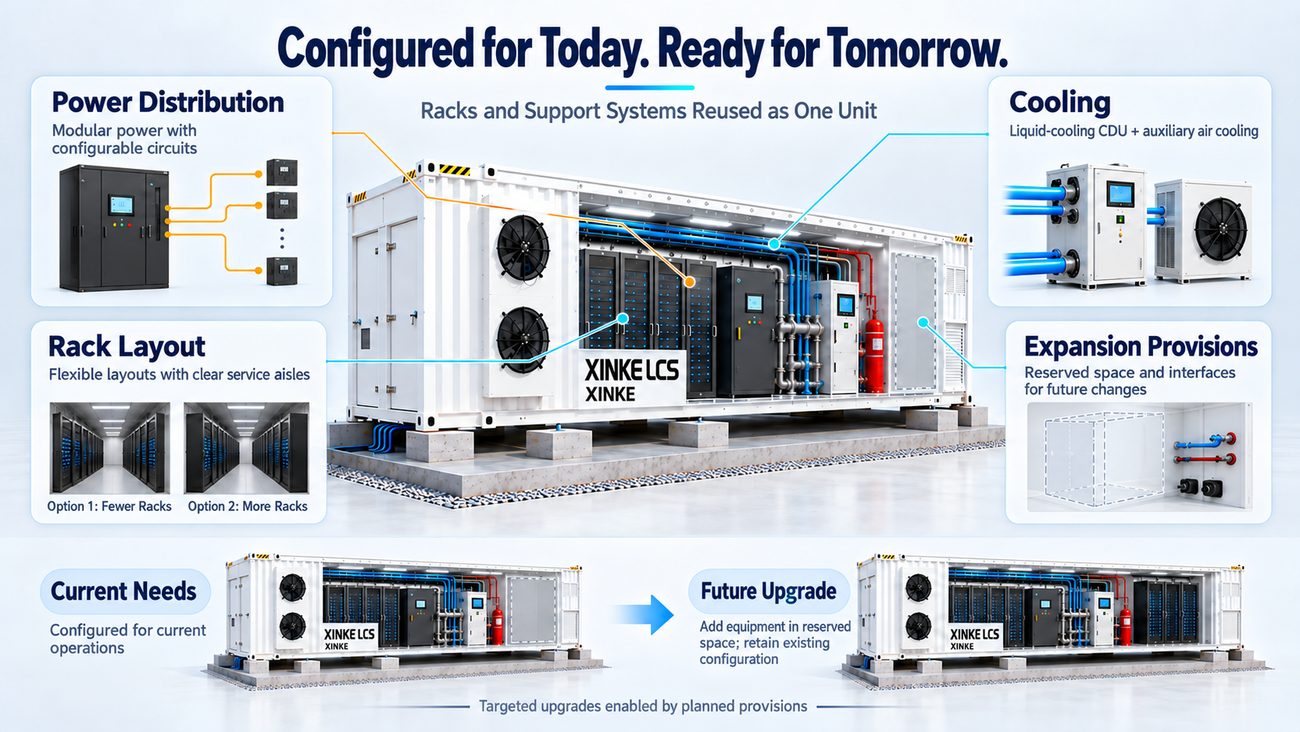
The solution design accounts for both future equipment replacement and business growth. By incorporating provisions for space, interfaces, and scalability, the design lays a foundation for future upgrades and capacity expansion, while minimizing the impact of subsequent adjustments on the existing deployment. The specific scope of these provisions and the capacity for expansion are determined based on project-specific load requirements and supporting infrastructure.
From initial configuration to future upgrades, Xinke integrates the client’s long-term development needs into the preliminary design, ensuring that the prefabricated modular container solution remains capable of continuously adapting to evolving business requirements.
From initial design to phased delivery, ensuring every client commitment is fulfilled.
Clients are concerned not only with equipment configuration, but also with whether their requirements are accurately understood, whether project progress is transparent, and whether the final deliverables meet their operational needs.
During the design phase, Xinke engages in detailed discussions regarding business workloads, site conditions, power supply/distribution, and cooling requirements to define the configuration, scope of delivery, and key interfaces. In the implementation phase, the project is structured around critical milestones—such as design finalization, factory integration, factory acceptance testing (FAT), on-site deployment, and operational verification—with regular progress updates and milestone sign-offs to ensure any project changes are managed effectively.
Standardized integration and testing within the factory allow for proactive quality control, while comprehensive documentation and sign-offs at each stage ensure the entire delivery process is fully traceable. Specific milestones and acceptance criteria are executed in accordance with the project agreement.
From an initial design blueprint to a fully functional system, our commitment to the client is reflected in every requirement confirmation, every test record, and every project milestone.
Leveraging years of deployment experience to provide the industry with new approaches to problem-solving
From the integration of blockchain supercomputing server containers in 2021 to the successful operation of modular data center units across various locations in China, Xinke has consistently validated its technology through real-world deployments, leveraging project experience to drive product iteration.
The continuous refinement of our prefabricated modular container solutions—integrating rapid deployment, asset reuse, flexible configuration, and end-to-end delivery—provides a practical, implementable choice for building computing capacity.
Leading industry development through action and reshaping the industry landscape through technology, Xinke remains committed to driving innovation via on-the-ground implementation, ensuring that modular computing infrastructure reaches the places where it is needed most—faster than ever.