

Liquid Cooling Retrofit Checklist for Existing Data Centers

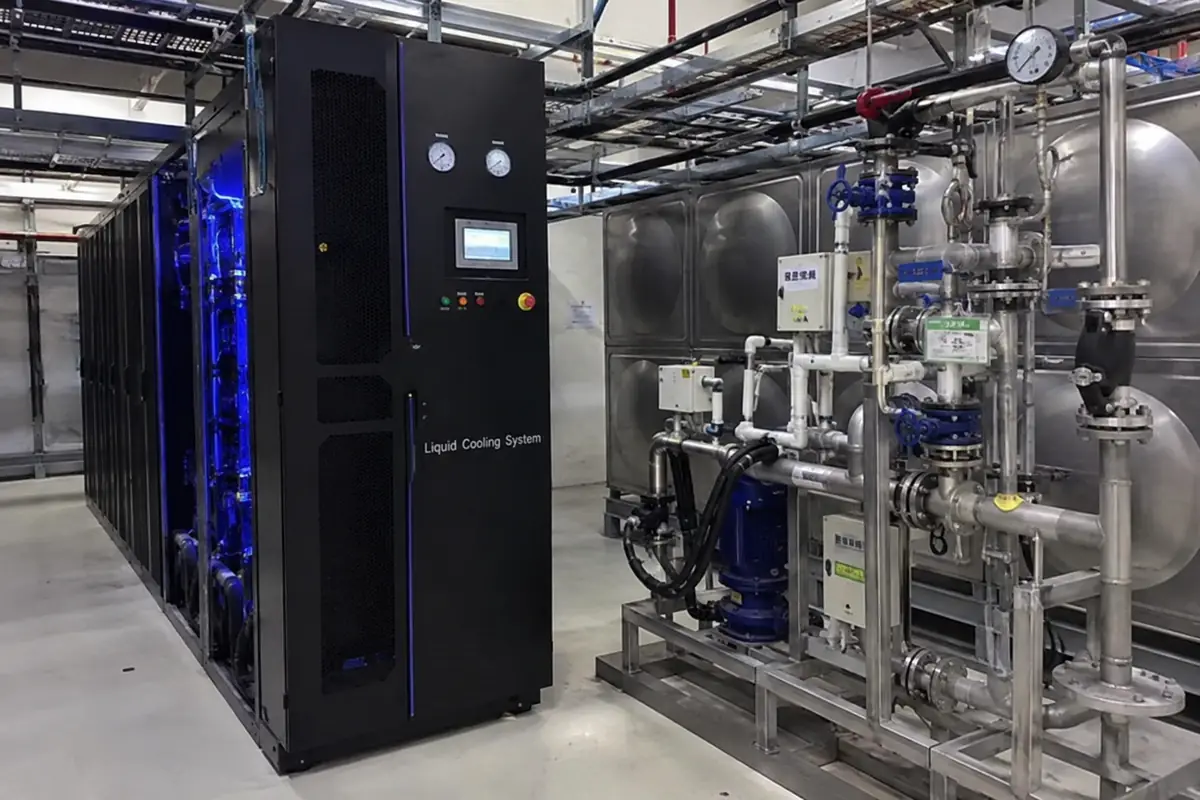
As AI and HPC workloads increase, many existing data centers face a new challenge: their air-cooling infrastructure was designed for traditional servers, while new GPU racks require much higher power density.
Can an existing data center be retrofitted for liquid cooling? In many cases, yes—but a successful retrofit requires much more than installing a coolant distribution unit (CDU). The project may involve the facility water loop, pumps, heat exchangers, electrical distribution, server racks, leak detection, monitoring, and maintenance procedures.
Can an Existing Data Center Be Retrofitted for Liquid Cooling?
Feasibility depends on the condition and capacity of the existing infrastructure. Before selecting a CDU or purchasing GPU servers, evaluate cooling capacity, chilled-water availability, flow and pressure, electrical capacity, rack density, floor loading, pipe-routing options, water quality, leak-management requirements, and BMS/DCIM integration.
| Existing Condition | Retrofit Outlook | Typical Requirement |
|---|---|---|
| Sufficient cooling and electrical capacity | Usually feasible | Add CDU, manifolds, controls, and leak detection |
| Limited water-loop capacity | Feasible with modifications | Upgrade pumps, heat exchangers, or heat rejection |
| High-density GPUs in a low-density room | Requires major modification | Review racks, power, cooling, and floor loading |
| No practical water source near the IT room | Higher complexity | Consider a new loop or alternative architecture |
Choose the Right Liquid-Cooling Retrofit Architecture
Direct-to-chip cooling uses cold plates attached to GPUs and CPUs. It is suitable for high-density AI and HPC racks, but requires compatible servers, manifolds, hoses, and hydraulic design.
Rear-door heat exchangers remove heat from air leaving the rack. They can be useful when existing servers are not designed for direct liquid cooling.
Immersion cooling places servers in dielectric fluid. It supports high density but requires major changes to server configuration, maintenance, and facility layout.
Hybrid cooling combines liquid cooling for GPUs or CPUs with air cooling for memory, storage, networking, or other components. This is often practical for mixed-generation equipment.
| Architecture | Best Use Case | Retrofit Complexity | Main Consideration |
|---|---|---|---|
| Direct-to-chip | High-density GPU and HPC racks | Medium to high | Server and manifold compatibility |
| Rear-door heat exchanger | Existing air-cooled servers | Medium | Rack layout and water availability |
| Immersion | Specialized high-density deployments | High | New maintenance and fluid-handling model |
| Hybrid cooling | Mixed server environments | Medium | Coordination of air and liquid systems |
Retrofit Checklist 1: Assess the Existing Cooling System
Document the current CRAC and CRAH units, chilled-water supply and return temperatures, available flow, differential pressure, pump capacity, cooling-tower or dry-cooler capacity, seasonal conditions, water treatment, control valves, and heat-rejection limits.
The system must be checked at peak summer conditions and during maintenance scenarios—not only under ideal conditions.
| Existing System Item | What to Inspect | Possible Retrofit Action |
|---|---|---|
| Chilled-water loop | Temperature, flow, and pressure | Add branch loop, pump, or heat exchanger |
| Pumps | Available head and operating point | Upgrade or add variable-speed pumps |
| Heat rejection | Seasonal capacity | Add dry cooler, tower, or heat exchanger |
| Controls | Sensors and communication | Integrate with BMS or DCIM |
Retrofit Checklist 2: Plan the CDU and Water Loops
The CDU separates and manages the facility-side loop and the IT-side coolant loop. It may provide heat exchange, pumping, temperature control, flow control, filtration, expansion management, leak detection, alarms, and BMS or DCIM communication.
Select the CDU using the complete thermal and hydraulic design, including liquid-cooled heat load, supply and return temperatures, coolant type, rack flow, pressure drop, facility-water temperature, primary-side flow, redundancy, and expansion requirements.
Build a Pressure-Drop Budget
| Component | Pressure Drop at Design Flow | Data Source |
|---|---|---|
| GPU cold plates | [Enter value] | Server OEM |
| Rack manifolds | [Enter value] | Manifold supplier |
| Hoses and quick-disconnects | [Enter value] | Component supplier |
| Valves, fittings, filters, and piping | [Enter value] | Hydraulic calculation |
| CDU internal circuit | [Enter value] | CDU supplier |
| Total pump head required | [Total] | Final engineering review |
Ignoring pressure drop can result in insufficient flow at the farthest rack. Excessive pump head can create unstable control, noise, component stress, and increased leakage risk.
Retrofit Checklist 3: Review Power and Electrical Infrastructure
Review GPU rack density, busway and PDU capacity, UPS and generator capacity, CDU pump power, control-system power, dual power feeds, emergency shutdown logic, electrical-room capacity, and future expansion allowance.
Thermal and electrical planning must be performed together. A facility may have enough cooling capacity but insufficient power distribution for the planned GPU cluster.
Retrofit Checklist 4: Modify Cabinets, Racks, and Distribution
Check rack width and depth, server compatibility, rack weight rating, floor loading, manifolds, hose routing, quick-disconnects, cable-management space, service clearance, drip trays, and separation between air-cooled and liquid-cooled equipment.
High-density GPU racks can be significantly heavier than conventional server racks. Structural and floor-loading reviews should be completed before delivery.
Retrofit Checklist 5: Add Leak Detection and Water Safety
Leak prevention is a system-design requirement. Consider leak-detection cables, point sensors, CDU alarms, drip trays, containment, automatic isolation valves, pressure monitoring, double-sealed quick connectors, inspection procedures, and emergency response plans.
A typical response should define how an alarm reaches the BMS or DCIM, who receives it, whether the affected branch is isolated, and how maintenance personnel respond.
Retrofit Checklist 6: Integrate Monitoring and Controls
Liquid cooling requires more visibility than traditional air cooling. Monitor supply and return temperatures, differential pressure, flow, pump status, filter condition, valve position, CDU mode, leaks, high-temperature alarms, low-flow alarms, sensor faults, and historical trends.
XINKE LCS highlights intelligent liquid-cooling management, remote monitoring, automatic alarms, data storage, and Modbus compatibility as part of its solution approach.
Explore XINKE LCS liquid-cooling technology
Retrofit Checklist 7: Review Redundancy and Maintainability
| Architecture | Suitable For | Benefits | Limitations |
|---|---|---|---|
| N | Lower-criticality environments | Lower cost and simpler design | Failure may reduce available cooling |
| N+1 | Most production AI/HPC deployments | One component can fail or be serviced | Requires additional space and controls |
| 2N | Highly critical workloads | Independent duplicate capacity | Higher cost, footprint, and complexity |
Review redundancy for pumps, CDU modules, heat exchangers, power supplies, controllers, sensors, leak-detection circuits, and communication paths.
Redundancy is not the same as maintainability. Safe isolation, bypasses, service clearance, and appropriate control logic are also required.
Plan the Retrofit in Phases to Reduce Downtime
- Conduct a site survey.
- Inventory servers and racks.
- Calculate current and future heat load.
- Assess water and electrical capacity.
- Select the cooling architecture.
- Design the CDU and secondary loop.
- Install a pilot rack or test zone.
- Commission controls and leak detection.
- Verify temperature, flow, and pressure.
- Deploy additional GPU racks gradually.
- Train operators and document maintenance.
Common Retrofit Mistakes
- Choosing a CDU only by kW rating
- Ignoring the complete pressure-drop budget
- Assuming existing chilled-water capacity is sufficient
- Forgetting residual air-cooled heat
- Installing manifolds without service clearance
- Underestimating rack weight and floor loading
- Treating leak detection as an afterthought
- Ignoring water quality
- Retrofitting too many racks simultaneously
- Not confirming server OEM requirements
How XINKE LCS Can Support Your Retrofit Project
A successful retrofit begins with accurate project information. XINKE LCS can help project teams evaluate rack heat load, CDU capacity, flow and pressure-drop requirements, facility-side water conditions, pump and heat-exchanger configuration, leak detection, monitoring, redundancy, and site-specific customization.
Prepare the data-center location, number of racks, current and planned rack power, GPU platform, existing cooling details, supply and return temperatures, available water flow and pressure, electrical capacity, redundancy target, and project timeline.
Request a liquid-cooling retrofit assessment from XINKE LCS
Conclusion
An existing air-cooled data center may be suitable for liquid cooling, but feasibility must be proven through a complete review of cooling, water, power, racks, controls, leak protection, and maintenance requirements.
The most reliable strategy is to begin with a site survey, calculate the real thermal and hydraulic requirements, validate the design through a pilot deployment, and expand in controlled phases.
If your facility is preparing for high-density GPU deployment, contact XINKE LCS with your rack count, heat load, facility-water conditions, electrical capacity, and deployment timeline.
Frequently Asked Questions
Can an existing air-cooled data center be converted to liquid cooling?
Yes, in many cases. The facility must first be assessed for cooling capacity, water availability, electrical capacity, rack compatibility, floor loading, leak management, and monitoring.
What is the most practical liquid-cooling retrofit for GPU racks?
Direct-to-chip and hybrid cooling are often practical options. The correct choice depends on server compatibility, rack density, facility water, and the infrastructure that can be modified.
Does a liquid-cooling retrofit require a new water loop?
Not always. Some facilities can use an existing chilled-water loop through a properly designed CDU. Others require a dedicated secondary loop, new pumps, or new piping.
What changes are needed in existing server racks?
Potential changes include rack manifolds, supply and return hoses, quick-disconnects, containment, leak sensors, service clearance, and structural reinforcement.
How much downtime is required?
Downtime depends on the architecture, installation method, facility layout, and pilot strategy. Phased deployment can reduce disruption.