

The End of Air Cooling, the Beginning of Liquid Cooling: NVIDIA Blackwell Delivers Three Heavy Blows to the Thermal Industry


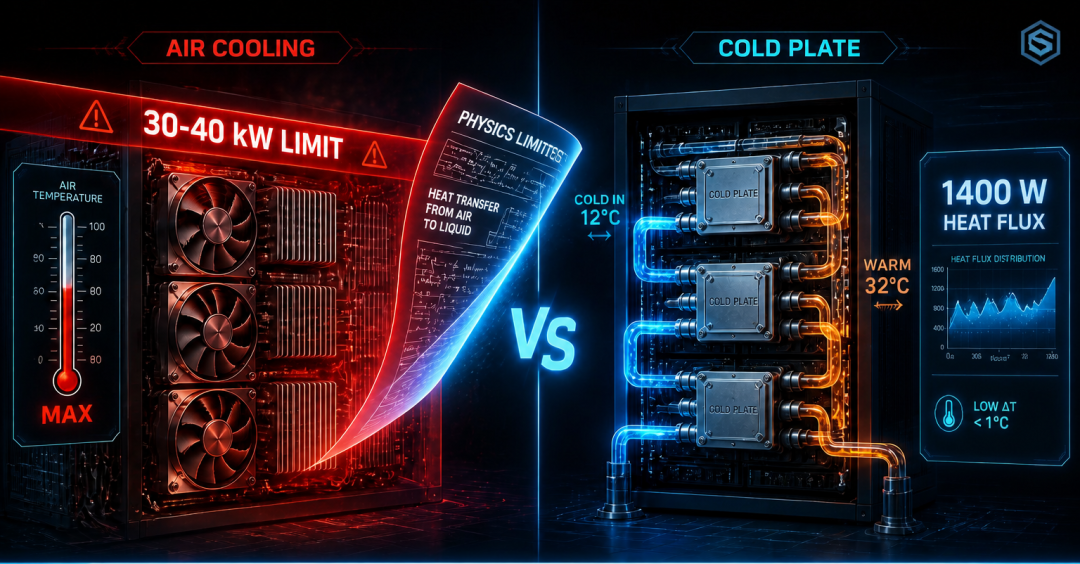
When NVIDIA GB300 enters mass production with a thermal design power of 1400W per unit and the total power consumption of a single NVL72 cabinet firmly exceeds 150 kilowatts, the physical ledger of traditional air cooling has thus turned to its last page. Five years ago, the power consumption of mainstream Gpus was no more than 300 watts. Now, it has increased nearly fivefold, and the air-cooling solution has reached its peak at 30 to 40 kilowatt-hours per cabinet. NVIDIA has made a clear ruling with Blackwell: for the next generation of AI computing power, there is no option for air cooling. From chips to entire cabinets, from power consumption to water consumption, Blackwell’s three powerful hammers are redefining the rules of the game in the entire liquid cooling industry.

The first strike: The physical limit of air cooling is broken through
The 1400W of a single GB300 chip means that the heat flux density per square centimeter of the chip area has approached the level of a nuclear reactor. The heat capacity and thermal conductivity of air simply cannot complete such a magnitude of heat transfer within a reasonable volume. In terms of the entire cabinet dimension, NVL72 integrates 72 Gpus through NVLink full interconnection, with a single cabinet power consumption of 150-155 kilowatts -15 to 30 times the design power of traditional cabinets.
According to a report by CCID Consulting, the market size of liquid-cooled data centers in China reached 15.98 billion yuan in 2025, with a year-on-year growth of 45.2%. It is expected to increase from 23.25 billion yuan to 47.04 billion yuan from 2026 to 2028. Cold plate type accounts for more than 85% of the market share, and immersion growth is equally rapid. These are no longer predicted figures, but orders that have already been placed and cold stations under construction.
The second hammer: Liquid cooling has been upgraded from an optional feature to a factory standard
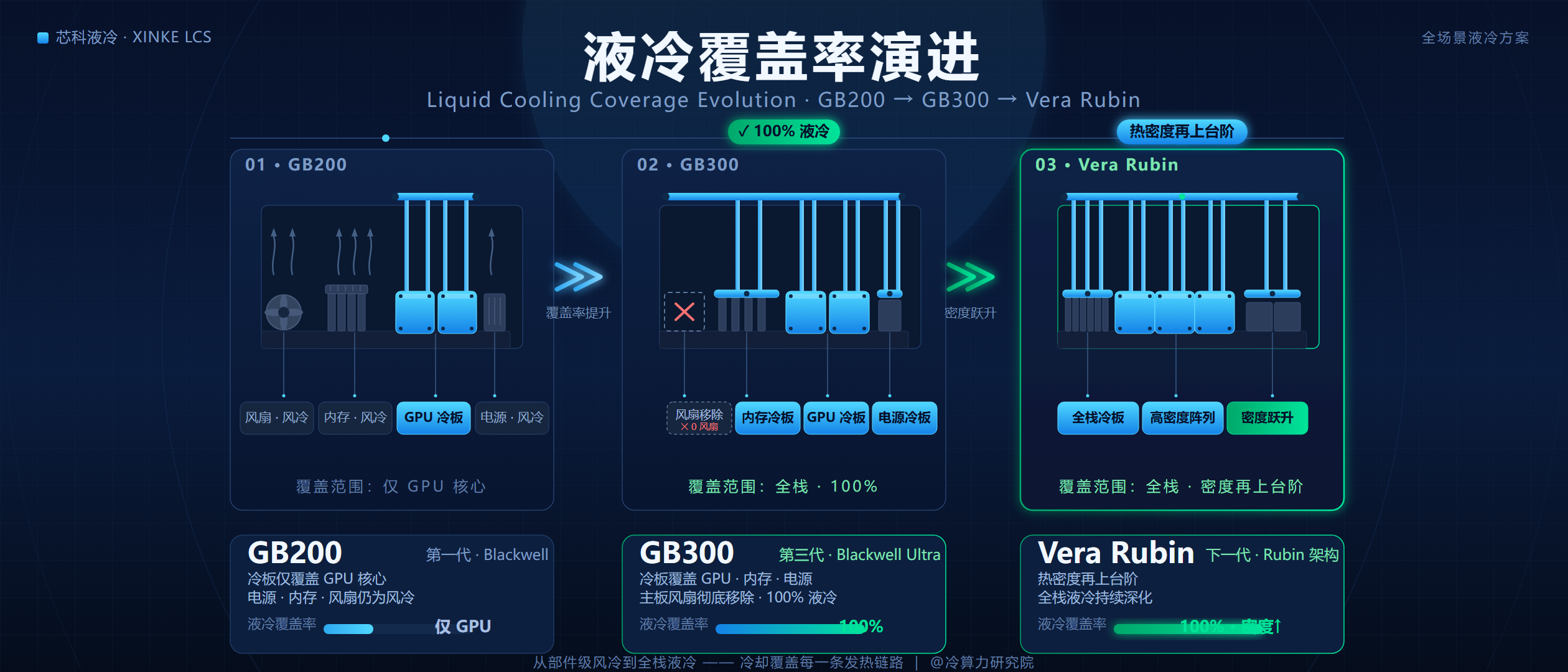
NVIDIA’s attitude towards liquid cooling has gone through three clear stages: in the GB200 era, the cold plate only covered the GPU, while air cooling was responsible for the rest of the components; In the GB300 era, the coverage of cold plates was expanded to all high-power consumption areas such as power supplies and memory, and the motherboard fans were completely removed, with liquid cooling coverage reaching 100%. In the forward-looking Vera Rubin era, the heat dissipation density has reached a new level, and a single solution will no longer be sufficient.
The most crucial dividing line lies in GB300. Starting from the first quarter of 2026, full supply began. Leading Oems such as Dell, AMD, and HPE simultaneously launched liquid-cooled complete machines. The Blackwell series will account for over 70% of NVIDIA’s high-end GPU shipments. Liquid-cooled full cabinets are no longer an experimental project for pioneering customers, but a mainstream delivery form for global AI infrastructure. The logic that a lack of liquid cooling means a lack of computing power has gone from a slogan to an order.
The third hammer: Zero water consumption closed loop, not only addressing heat but also water
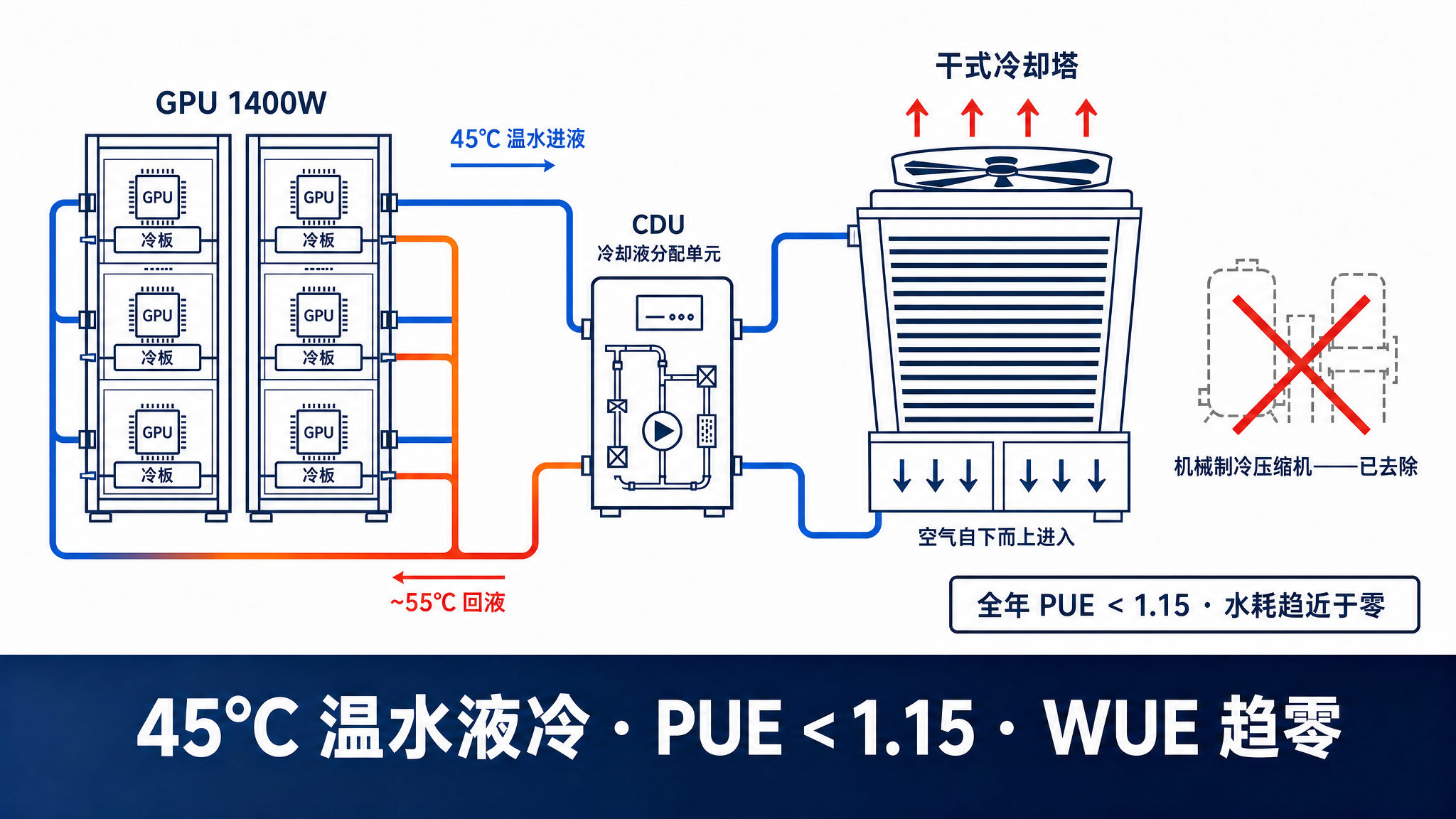
Traditional data centers are major water consumers. A 100MW facility may consume millions of tons of water each year. In June 2026, NVIDIA launched a 45°C warm water liquid cooling system – with a sufficiently high inlet liquid temperature, the secondary side can be directly cooled by a dry cooling tower, eliminating the need for mechanical refrigeration compressors. The annual PUE pressure can be reduced to below 1.05, and water consumption approaches zero. Almost at the same time, Microsoft announced that the annual water consumption of its new AI data center would be reduced to the level of a restaurant, and it upgraded WUE to an enterprise-level hard constraint.
The shock wave of this hammer is spreading: high-temperature liquid cooling makes natural cooling the mainstream, and the cost of electricity is dropping simultaneously. WUE becomes a quantifiable and auditable contract indicator. The Middle East, Southeast Asia and other regions with high temperatures and water shortages have for the first time obtained the technical pass for large-scale deployment of AI computing power – liquid cooling capacity, which is rewriting the global computing power map.
Industrial chain reshaping: A Comprehensive Reconstruction from CDU to coolant
Changes in chip architecture never occur in isolation. When Blackwell pushed the single-cabinet heat dissipation demand to 150 kilowatts, every link in the liquid cooling industry chain was undergoing an upgrade. The CDU needs to leap from the traditional 300-500kW to the 2MW level. The operation at 45°C high temperature puts forward brand-new requirements for the thermal stability, antibacterial property and material compatibility of the coolant. The interface specifications and flow standards of GB300 NVL72 are becoming de facto industry standards. Liquid-cooled containers and micro-module solutions have evolved from optional to standard due to their plug-and-play feature.
Computing Power Ark: The Golden Window of China’s Liquid Cooling Supply Chain
NVIDIA’s three heavy hammers have objectively drawn a clear starting line. For Chinese liquid cooling enterprises, Blackwell’s global shipments and the rising power consumption of domestic computing chips form a dual-wheel drive. The key points of the “East Data West Computing” 2026 work require that 70% of the newly built super-large data centers at hub nodes adopt liquid cooling, and the PUE red line is tightened to 1.2.

Tangshan XINKE Intelligent Technology Co., LTD. (XINKE LCS) was established in 2018. It has a modern liquid cooling equipment production base covering an area of 30,000 square meters and an annual production capacity of over 500MW. The company takes “making computing power more efficient and energy greener” as its mission, providing complete solutions including CDU, liquid-cooled containers, micro-modules and waste heat recovery. Its products are exported to over 30 countries and regions around the world and serve more than 200 overseas data centers. From adapting to the extreme climate in Ohio, USA, to the multi-model hybrid deployment in Uzbekistan, and then to the 90% waste heat recovery in smart agriculture, XINKE LCS has marked the first batch of coordinates of “Made in China” on the global liquid cooling map.
This is not merely a business competition; it is an industrial narrative about the sovereignty of computing power. When liquid cooling is upgraded from a supporting component to a computing power foundation, enterprises that master efficient heat dissipation capabilities are defining the engineering standards for the next-generation AI infrastructure.
Conclusion
14 million is not a figure; it is a landmark of an era. NVIDIA Blackwell has completely torn off the old script in the cooling industry with three powerful hammers – the end of air cooling, the standard configuration of liquid cooling, and a zero-water-consumption closed loop. As the power consumption of a single chip surges from 1400W to 2000W, today’s liquid cooling solutions might also be referred to as transitional technologies. However, the first-mover advantage during the window period will determine the industry’s ranking in the next decade.
There is no end to computing power, and there is no way back for heat dissipation