

Why Deployment Can Stall After Server SelectionInfrastructure Requirements to Align Early


Even after servers have been selected, a project can stall before the equipment can be installed in racks. Constraints may include insufficient power, incompatible liquid cooling interfaces, lack of space for outdoor heat rejection equipment, or even a delivery route the equipment cannot pass through.
These issues often stem from information gaps between server selection and facility preparation.
On November 13, 2026, Schneider Electric outlined its collaboration with Giga Computing, a subsidiary of GIGABYTE, to develop a reference architecture for NVIDIA Vera Rubin NVL72, with coordinated planning for compute, power, liquid cooling, and management.
Infrastructure conditions should be confirmed alongside server selection, so that procurement, construction, and start-up proceed against the same set of requirements.
01 | From Equipment Selection to Deployment Planning
A server model alone is usually not enough to complete the facility design.
Equipment counts, rack density, and operating modes all affect facility requirements. Early in the project, define the number of units to deploy, how they will be distributed across racks, sustained and peak power demand, cooling methods, and expansion plans. Include supporting loads such as networking and storage equipment.
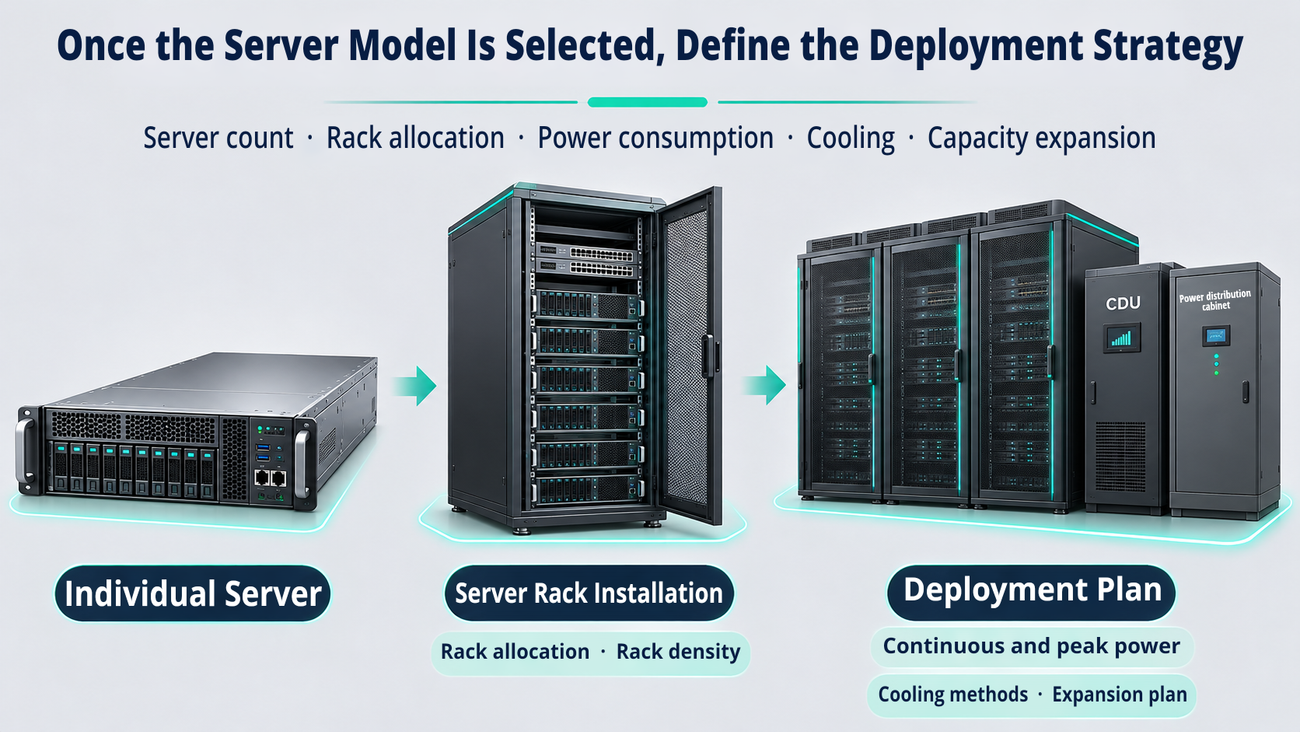
Clearly defining the equipment configuration and operating approach gives power and cooling design a shared basis.
02 | Verify Rack Power Delivery and Heat Rejection
Power delivery and heat rejection are two paths that require close coordination in high-density computing deployments.
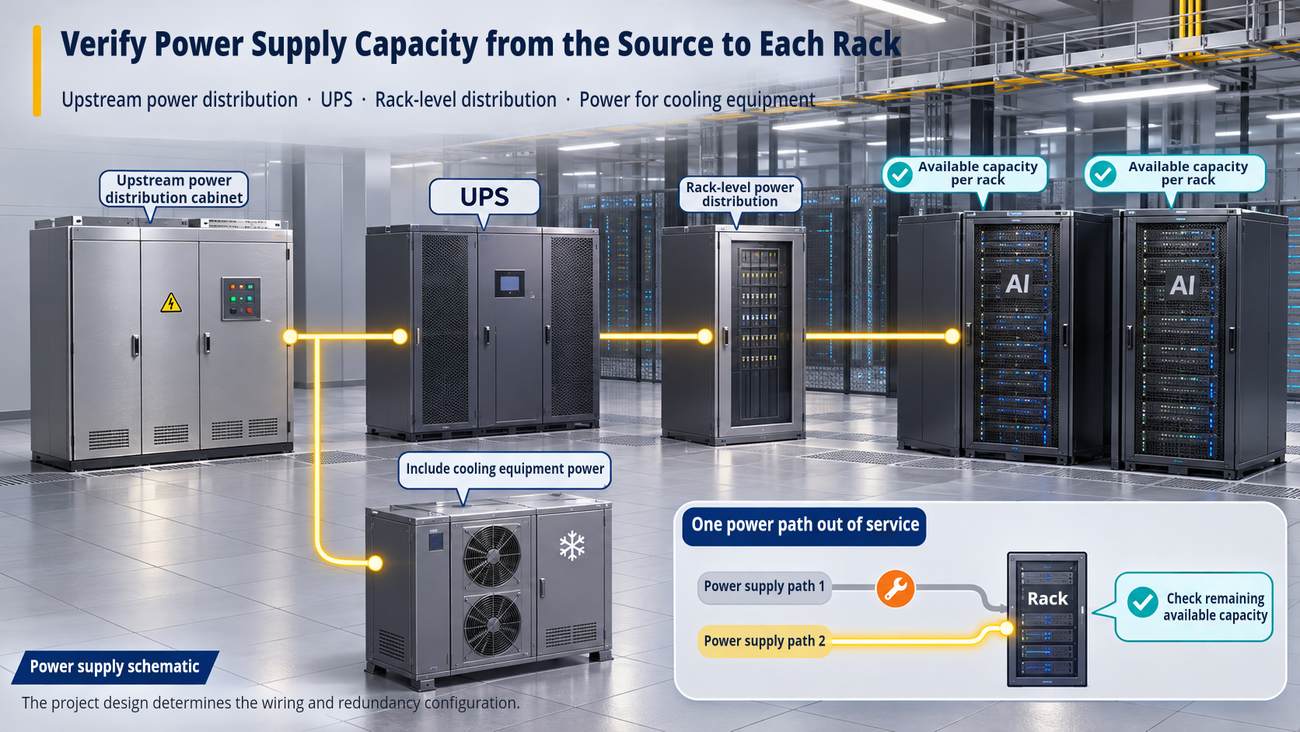
Verify power delivery to each rack. Even if the site has spare capacity, confirm that the transformers, switchgear, uninterruptible power supply (UPS) systems, and rack power distribution equipment can deliver it to the intended racks. Include cooling equipment power demand and verify available capacity with redundancy or maintenance requirements taken into account.
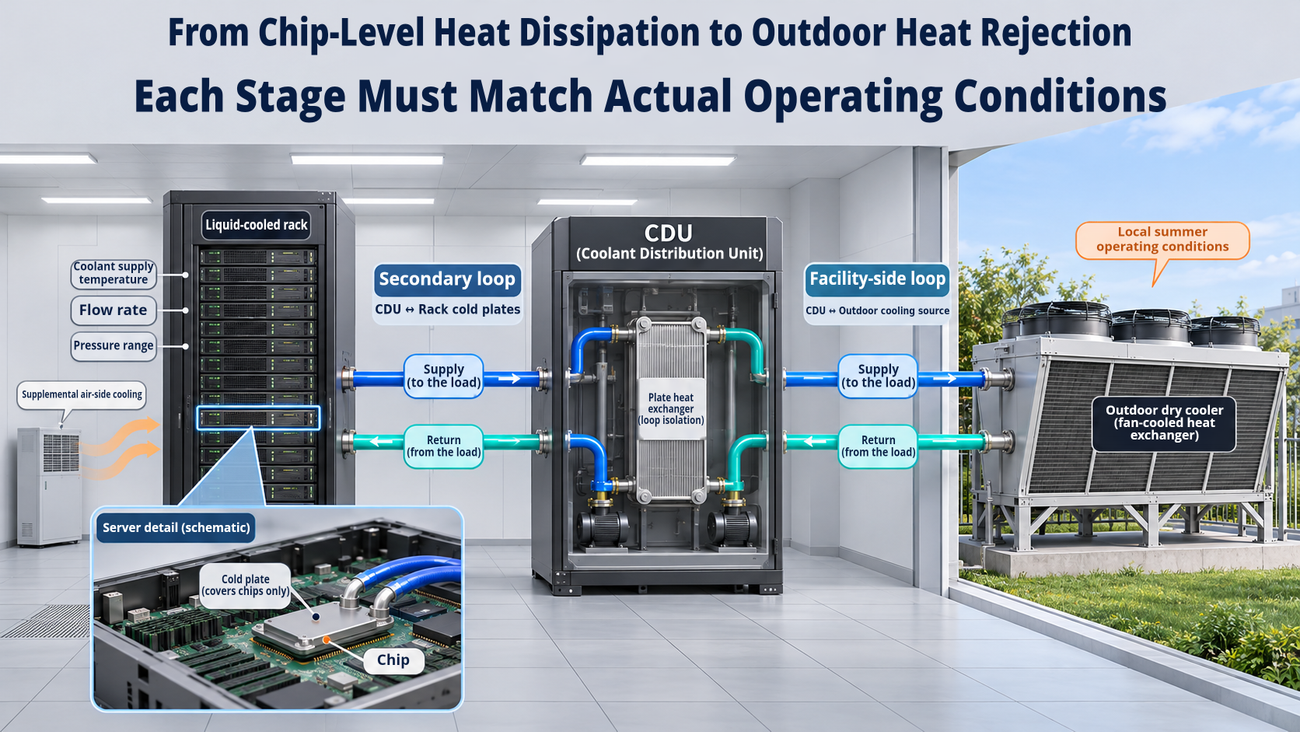
Validate cooling against actual operating conditions. The coolant distribution unit (CDU), piping, and facility-side cooling plant should be matched to the servers’ required supply coolant temperature, flow rate, pressure range, and coolant type. Outdoor heat rejection equipment should be selected for local summer conditions. Air-cooling capacity should also be provided for heat not captured by cold plates. Schneider Electric’s recent article on liquid cooling readiness likewise emphasizes jointly checking rack-level power, cooling parameters, and on-site heat rejection conditions.
Even when a CDU’s rated heat transfer capacity is sufficient, actual coolant supply conditions and piping resistance still need to be checked. Insufficient cooling supply or inadequate flow at the equipment can both limit usable capacity.
Every link must be in place, from the incoming power connection to the racks and from chip cooling to outdoor heat rejection.
03 | Allow Space for Equipment, Delivery, and Maintenance
Space planning can easily focus only on the floor plan: how many racks fit and how much space remains.
In practice, equipment transport, installation, and maintenance need to be considered together.
Space planning should confirm rack depth, load-bearing capacity for fully loaded racks, CDU service clearances, and pipe and cable routing. Doorways, elevators, and turning areas should also be checked against equipment handling requirements.
Outdoor deployments also require plans for positioning the computing pod, crane access routes, and heat rejection equipment locations, while accounting for the impact of construction on existing operations.
The earlier these conditions are confirmed, the more flexibility remains to adjust the layout and construction plan.
04 | Define Responsibilities for Interfaces and System Acceptance
Server hardware, liquid cooling, power distribution, networking, and construction involve multiple parties. Responsibility for connections, integration testing, and overall system acceptance should be defined early.
We recommend preparing an interface and delivery checklist at the design stage:
| Coordination item | Details to confirm |
| Electrical interfaces | Voltage, connection points, capacity, and each party’s scope of supply |
| Liquid cooling interfaces | Connector specifications, connection locations, coolant, and operating parameters |
| Monitoring interfaces | Communication protocols, data points, and requirements for alarms and coordinated control actions |
| Site conditions | Responsibility for preparing the site, piping, cooling plant, and network |
| Testing and delivery | Integration test scope, acceptance criteria, responsible parties, and completion milestones |
Server arrival dates should also be coordinated with power supply, cooling plant, and network readiness, as well as site readiness for installation.
Both equipment delivery and system start-up milestones should have clear completion criteria.
05 | Prefabricated Modules Enable Earlier Integration
For projects with multiple high-density racks or phased expansion, racks, CDUs, power distribution, temperature control, and monitoring can be designed together as a single module.
Prefabricated modular data center containers can be assembled, connected, and tested as an integrated system at the factory, then positioned on site, connected to external interfaces, and commissioned.
This approach moves interface coordination earlier in the process and makes it easier to agree in advance how future modules will connect to power, cooling, and the network.
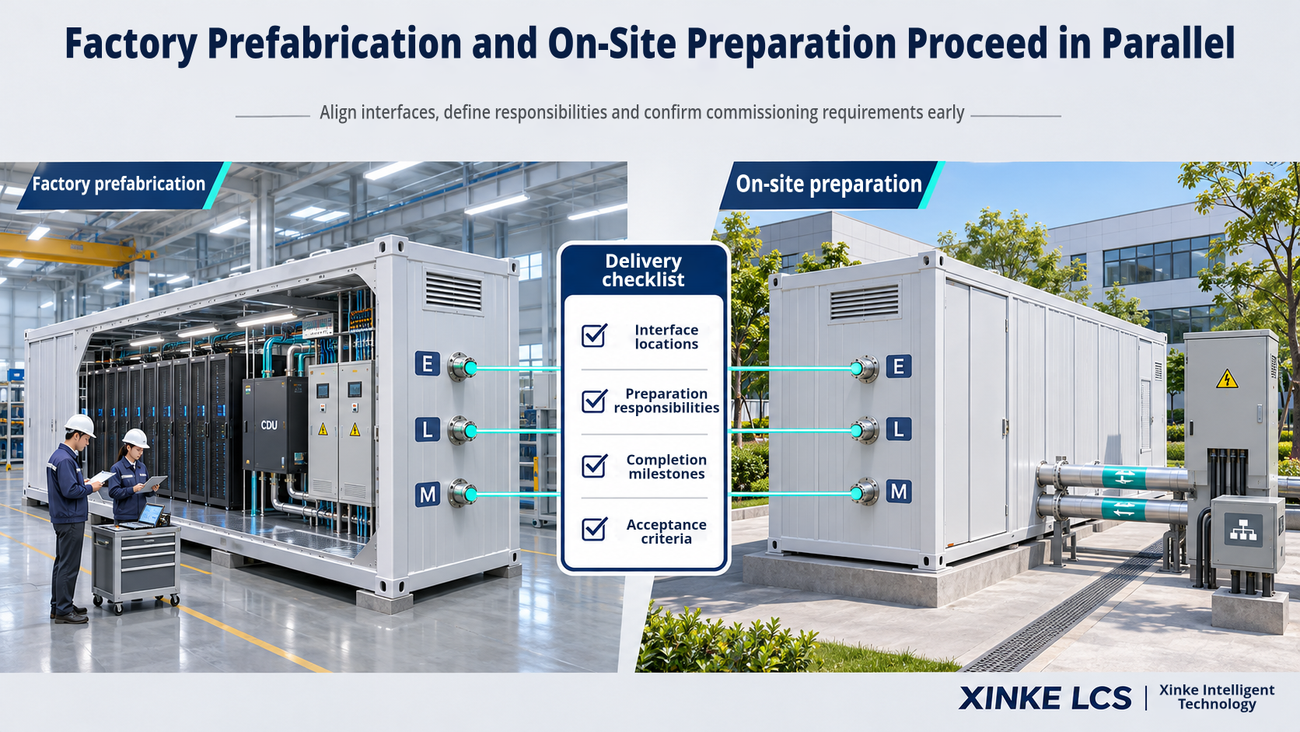
Supporting site infrastructure, including the upstream power supply, site foundations, and external cooling or heat rejection facilities, still needs to be put in place in parallel.
XINKE LCS offers CDUs, liquid-cooled micro-modules, prefabricated modular data center containers, and related solutions. We can coordinate power, cooling, and system integration based on server requirements, site conditions, and expansion needs.
Aligning specifications, interfaces, site conditions, and delivery responsibilities during equipment selection helps the project move smoothly from equipment arrival to computing capacity coming online.