

Does Liquid Cooling Require a Major Retrofit?From One Server to a Standalone Computing Pod

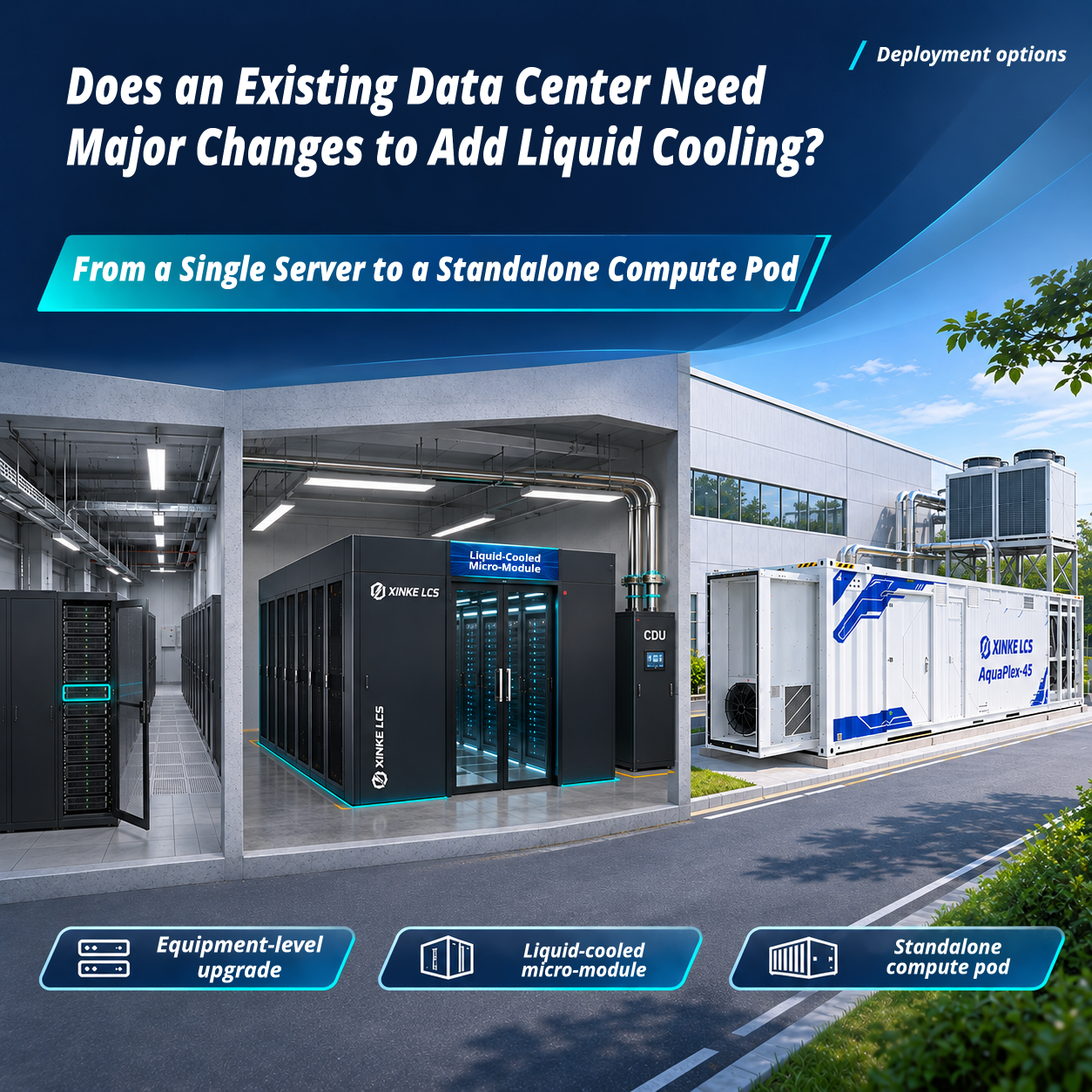
When AI compute capacity is needed, servers can be purchased, but the facility may not be ready to accommodate them.
Adding high-density equipment to an existing air-cooled facility often raises issues with power distribution, air conditioning, pipe routing, and maintaining service continuity during construction.
On November 17, 2026, Nexalus and RENDA announced the launch of the Nova8 liquid-cooled AI server. According to the manufacturers, its self-contained liquid cooling design allows installation in standard racks without additional liquid cooling piping.
Existing facilities can introduce liquid cooling through selected equipment or by adding standalone modules. The retrofit scope depends on the new load, existing capacity, and expansion plans.
01 | Where Does the Heat Go When Servers Use Liquid Cooling?
Liquid cooling changes how heat is transferred. The heat generated by servers still has to be removed.
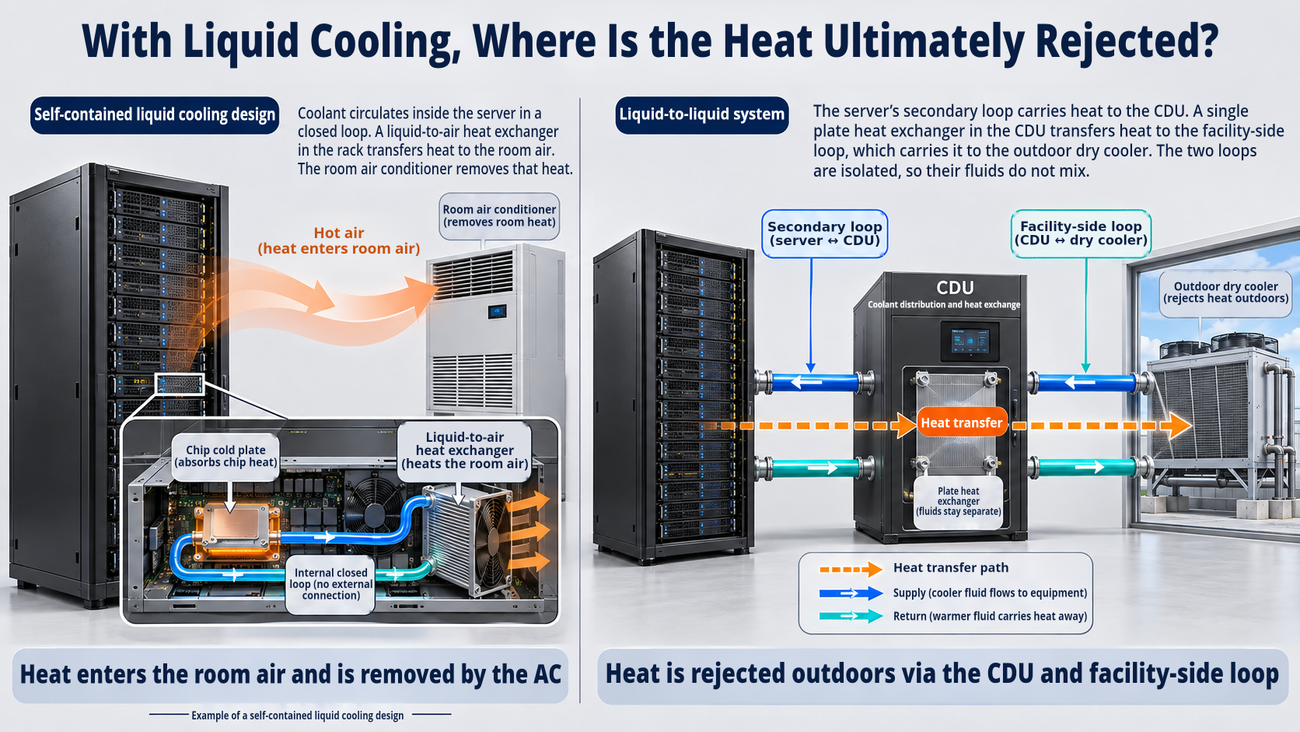
After cold plates transfer chip heat to the coolant, a heat exchanger can transfer this heat to room air for the air-conditioning system to remove. Alternatively, a coolant distribution unit (CDU) can transfer the heat to the facility-side loop for rejection by outdoor equipment.
Liquid-to-air cooling can reduce some of the piping work, but the existing air-conditioning system must be able to handle the additional heat load.
First, confirm which system will remove the heat and how much spare capacity remains along that heat rejection path.
02 | Start Small with Equipment-Level Upgrades
Internal model applications, R&D testing, or small-scale inference can start with a few equipment upgrades.
Designs such as Nova8 integrate liquid cooling loops, heat exchangers, and fans within the server, reducing reliance on added liquid cooling infrastructure. Conventional air-cooled servers need separate checks for retrofit feasibility and original manufacturer support.
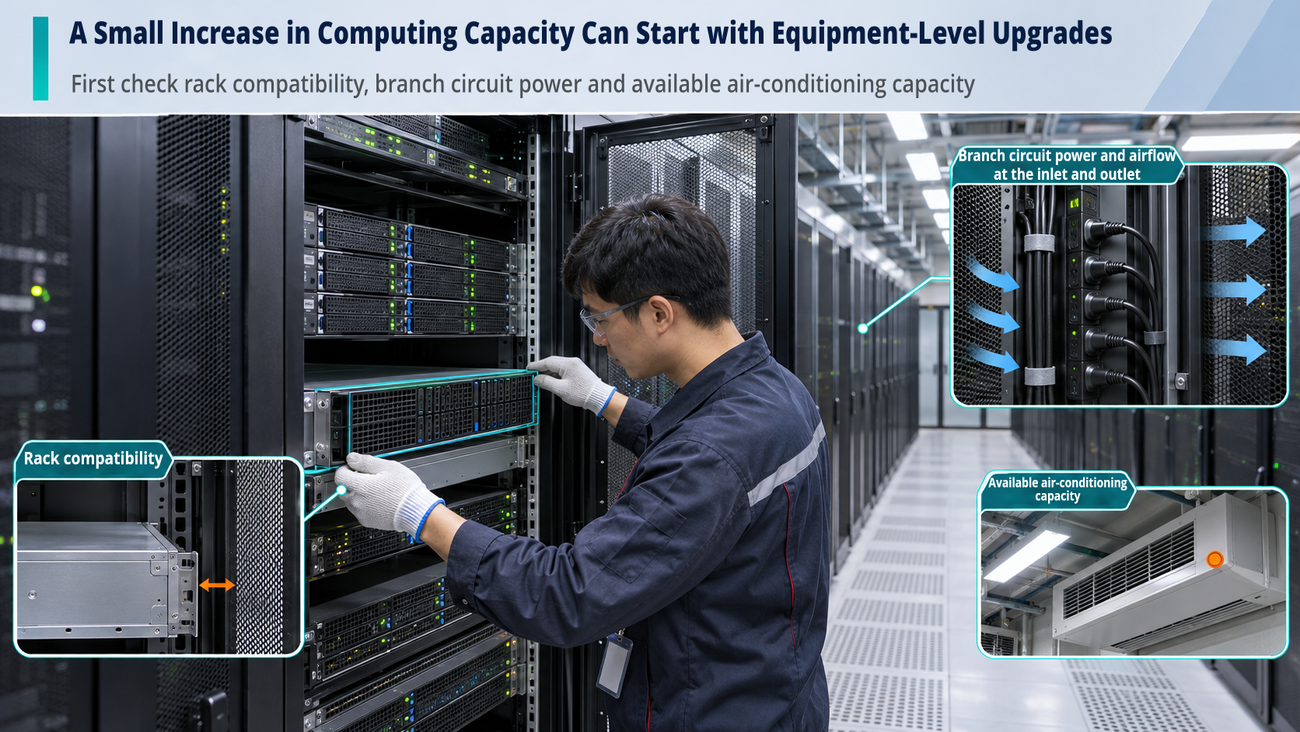
Before installing the equipment in racks, check rack depth and load-bearing capacity, branch-circuit power, inlet and exhaust air clearances, and spare air-conditioning capacity in hot weather.
Equipment-level upgrades suit projects of limited scale where the facility still has spare capacity, but future expansion also needs to be considered.
03 | Plan Larger Deployments with Liquid-Cooled Micro-Modules
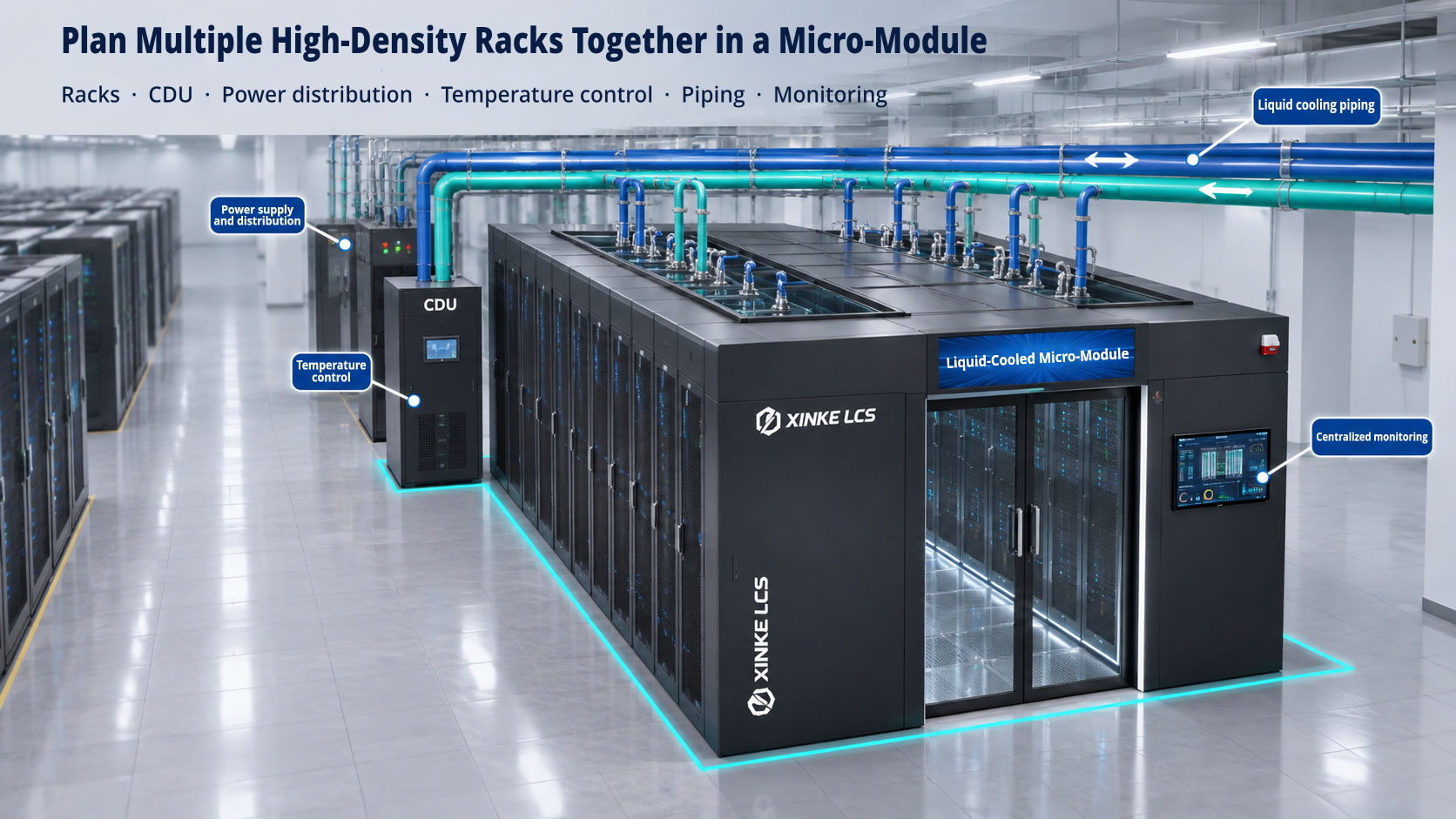
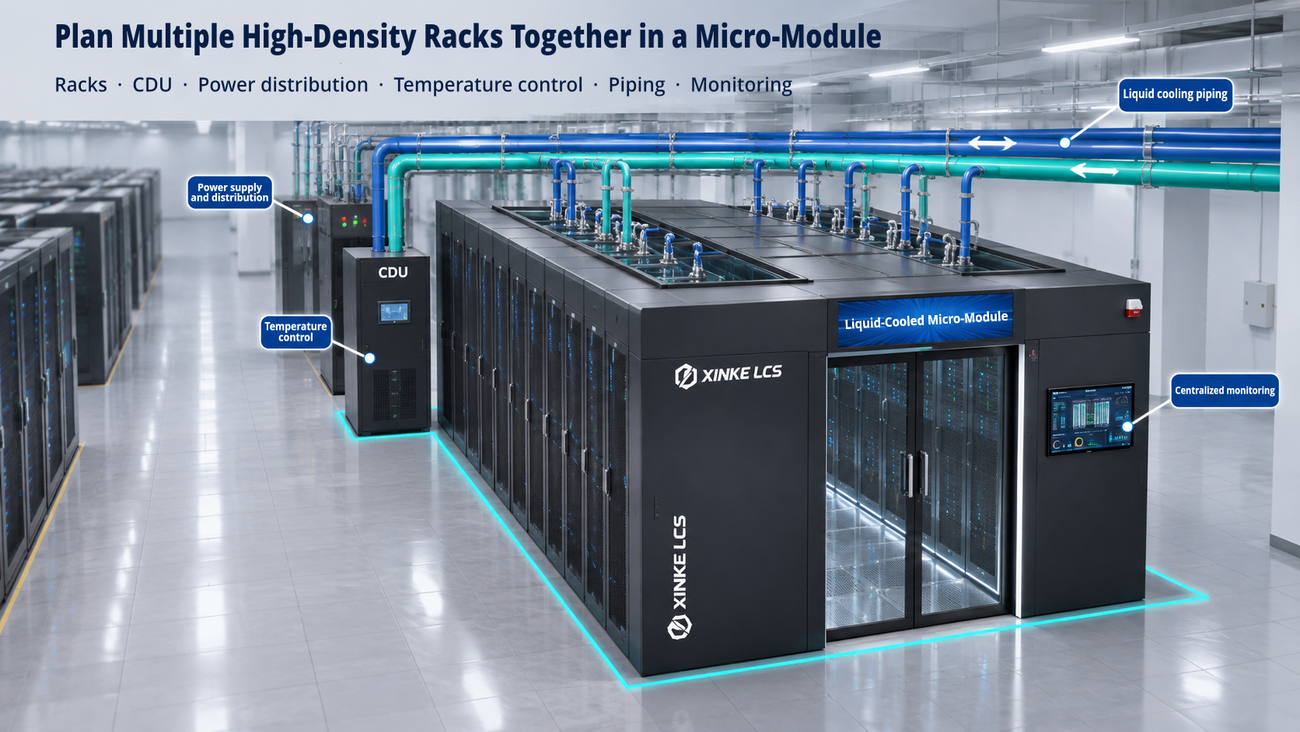
When requirements expand to multiple high-density racks, a dedicated liquid cooling area can be designated, with racks, CDUs, power distribution, temperature control, piping, and monitoring planned together within a micro-module.
A liquid-to-liquid CDU thermally couples the server-side and facility-side loops through a heat exchanger. Depending on its configuration, it also provides circulation, filtration, temperature control, and monitoring. Outdoor heat rejection equipment needs to be matched to server requirements and local climate conditions.
Components not cooled by cold plates may still require air cooling. Residual heat and aisle airflow should also be addressed in the overall design.
The benefit of a micro-module is coordinated planning for power, cooling, and management in the new high-density area.
This approach suits facilities where space, power, and cooling capacity can be expanded. Construction can be phased by area, with clearly defined connection and isolation boundaries.
04 | Standalone Computing Pods When Internal Retrofits Are Limited
Where space, load-bearing capacity, piping, or construction windows are constrained, a standalone computing pod can be considered if suitable space and supporting infrastructure are available on the site.
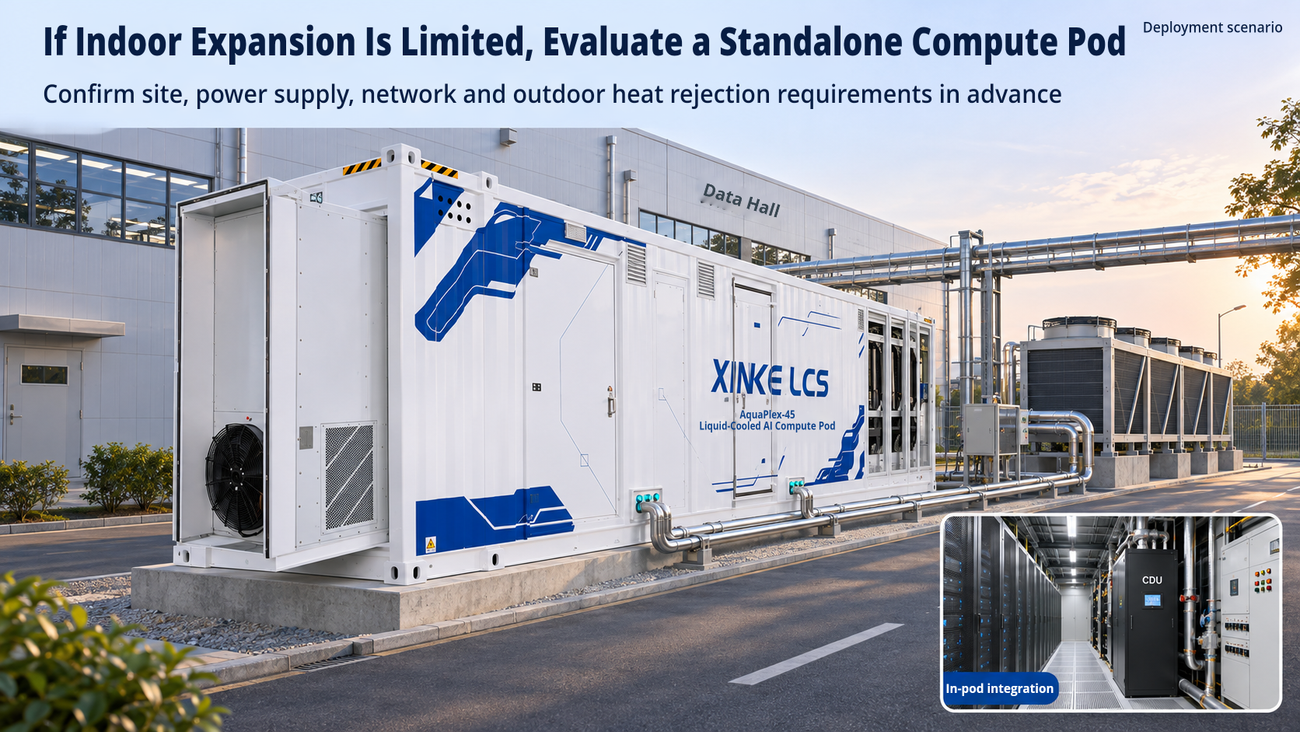
A prefabricated modular computing pod integrates racks, CDUs, power distribution, temperature control, monitoring, and fire protection within the enclosure. Assembly and integration testing are completed at the factory, followed by placement, connection, and commissioning on site.
Schneider Electric has also recently identified prefabricated modular IT pods as an option for phased expansion when internal retrofits are constrained.
New loads can be deployed in a standalone module while the existing facility continues to support existing services, making it easier to plan and maintain the two environments separately.
Foundations, crane access routes, power, networking, grounding, outdoor heat rejection facilities, and piping interfaces still need to be prepared on site in advance.
05 | Choose a Route Based on Current Conditions and Future Plans
Each of the three approaches suits different conditions and can complement the others at different stages of growth.
| Upgrade path | Best suited to | Conditions to confirm first |
| Equipment-level upgrade | Small additions to compute capacity and application pilots | Server design, rack compatibility, branch-circuit power, and spare air-conditioning capacity |
| Liquid-cooled micro-module | Multiple high-density racks deployed together | Available space, cooling supply connections, pipe routing, and construction windows |
| Standalone computing pod | Internal expansion is constrained, but space is available on site | Site conditions, upstream power supply, networking, outdoor heat rejection, and provisions for further expansion |
At the outset, allow for the next phase’s power distribution, piping, and heat rejection needs to reduce duplicated investment.
When comparing options, consider the costs of procurement, construction, workload migration, operations and maintenance, and expansion together.
06 | XINKE LCS Deployment Options for New Compute Capacity
XINKE LCS offers solutions including CDUs, liquid-cooled micro-modules, and prefabricated modular data center containers, and can help plan a deployment approach around existing facility conditions.
Liquid-cooled micro-modules support coordinated planning for new indoor areas, while prefabricated computing pods provide a standalone expansion option for projects with suitable site conditions.
Introducing liquid cooling into an existing facility does not necessarily require a complete retrofit. Identify which infrastructure can be retained and what additional provisions are needed to choose the right starting point.
Assess existing conditions and reserve capacity for the next stage so liquid cooling upgrades can progress steadily as the business grows.